
Home Workouts vs. Gym Training: Weighing Your Options
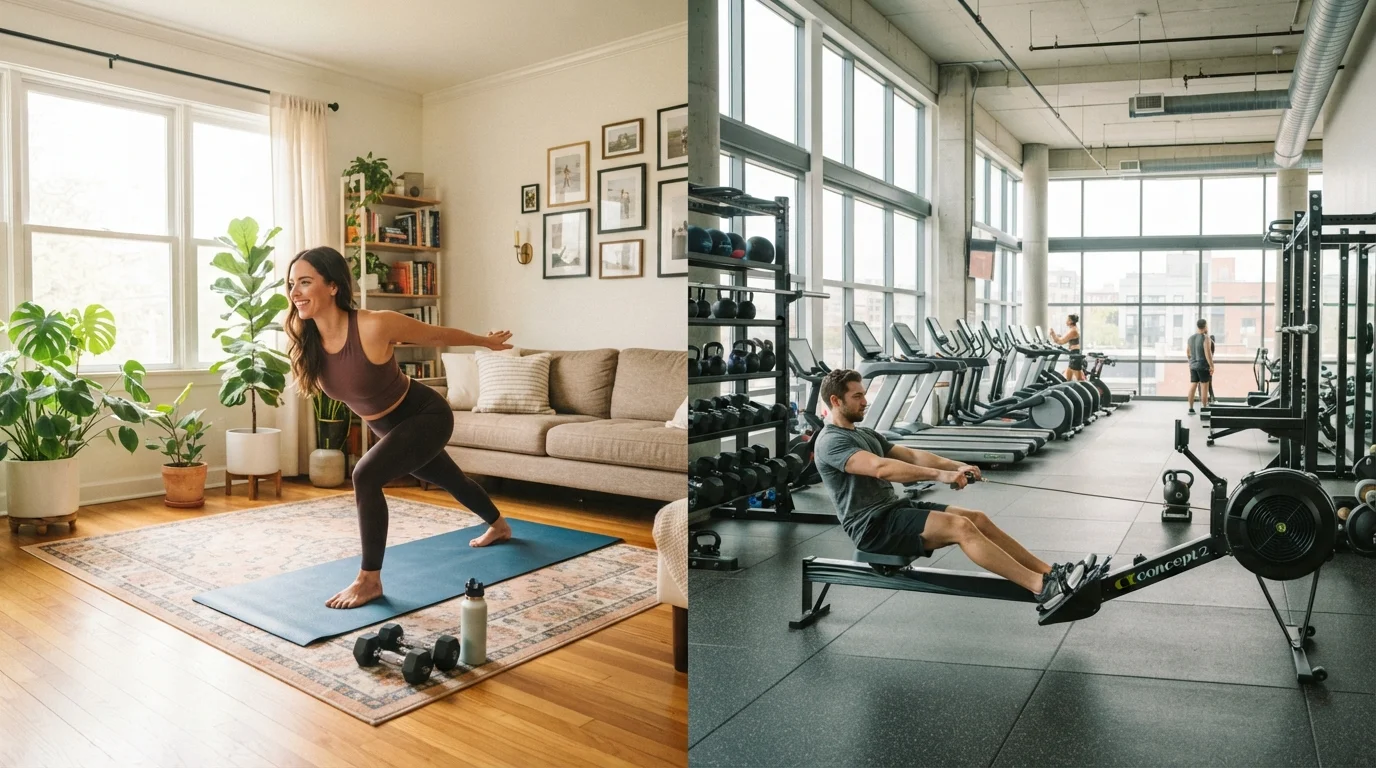
Photo credit: SkripTee.com | Search. Explore. Learn.
In this article
Both home and gym environments offer distinct advantages and limitations. Learn what to consider when deciding where your fitness routine fits best.
Key Takeaways
- Home workouts offer convenience and privacy; gyms provide equipment variety and social structure.
- Neither setting is inherently superior - the best choice depends on your goals, budget, and lifestyle.
- Consistency is the strongest predictor of fitness progress, regardless of where you exercise.
- Many people benefit from blending both environments across different times of year.
- Always consult a qualified professional before starting a new fitness routine, especially with existing health conditions.
No commute - train on your own schedule
Removing travel time eliminates one of the most commonly cited barriers to exercise. Sessions can happen before work, during lunch, or in short windows that a gym trip wouldn't allow.
Lower long-term cost once set up
A modest home setup - mat, resistance bands, adjustable dumbbells - involves one-time spending rather than monthly fees, which can represent meaningful savings over several years.
Privacy and personal comfort
Many beginners feel self-conscious in a gym environment. Training at home removes that psychological barrier entirely, allowing people to focus on learning movements without social anxiety.
Access to a wider equipment range at gyms
Commercial gyms offer barbells, cable stations, and specialty machines that support a broader range of exercises and progressive overload strategies than most home setups can match.
Built-in social and accountability structure
A gym environment - other people working out, staff presence, scheduled classes - can provide external motivation that home environments don't naturally offer.
Professional guidance more accessible
Many gyms offer access to personal trainers or group instructors, making it easier to get form feedback and programming support, particularly valuable for beginners.
Equipment ceiling limits advanced progression
Bodyweight and light resistance training support early-stage fitness well, but those pursuing significant strength gains often need heavier loads that require substantial home investment or a gym.
Home distractions undermine focus
Household obligations, family members, and familiar surroundings can interrupt sessions and make it harder to sustain the mental engagement that productive training requires.
No built-in form feedback at home
Without mirrors, coaches, or training partners, errors in movement technique can go unnoticed and become entrenched habits, which carries a greater risk for complex or loaded exercises.
Gym costs are recurring and can add up
Monthly membership fees, initiation charges, and potential add-ons like locker rental or class packages mean gym training has an ongoing cost that compounds over time.
Commute time reduces practical accessibility
Travel to and from a gym adds meaningful time to each session, which can be a real barrier for people with tight schedules - particularly on weekdays.
Gym environments can feel intimidating
Beginners may find busy gym floors socially daunting, which can reduce enjoyment and, in some cases, lead to avoidance of the setting altogether.
What Each Setting Actually Offers
When weighing home workouts against gym training, it helps to start with a clear picture of what each environment genuinely provides - not an idealized version, but what most people realistically experience day to day.
A home workout space can be as minimal as a cleared living room floor or as equipped as a dedicated room with resistance bands, adjustable dumbbells, and a pull-up bar. The defining feature is control: you set the schedule, the temperature, the music, and the pace. There are no commute costs, no wait times for equipment, and no membership fees once your setup is in place.
A gym, by contrast, offers infrastructure that is difficult to replicate at home without significant investment. That typically includes barbells and full weight stacks, cable machines, cardio equipment, and often group fitness classes or personal training access. For exercises that benefit from progressive overload - gradually increasing resistance over time - a well-equipped gym makes the progression easier to manage. See our guide to balancing strength training and cardio to understand how equipment access can shape your weekly structure.
No commute - train on your own schedule
Removing travel time eliminates one of the most commonly cited barriers to exercise. Sessions can happen before work, during lunch, or in short windows that a gym trip wouldn't allow.
Lower long-term cost once set up
A modest home setup - mat, resistance bands, adjustable dumbbells - involves one-time spending rather than monthly fees, which can represent meaningful savings over several years.
Privacy and personal comfort
Many beginners feel self-conscious in a gym environment. Training at home removes that psychological barrier entirely, allowing people to focus on learning movements without social anxiety.
Access to a wider equipment range at gyms
Commercial gyms offer barbells, cable stations, and specialty machines that support a broader range of exercises and progressive overload strategies than most home setups can match.
Built-in social and accountability structure
A gym environment - other people working out, staff presence, scheduled classes - can provide external motivation that home environments don't naturally offer.
Professional guidance more accessible
Many gyms offer access to personal trainers or group instructors, making it easier to get form feedback and programming support, particularly valuable for beginners.
Where Home Training Falls Short
Home workouts have real limitations that are worth acknowledging honestly. The most common friction point is equipment ceiling - bodyweight exercises and light resistance tools can take beginners far, but advanced strength goals often require heavier loads than most home setups accommodate affordably.
Motivation can also be harder to sustain without external cues. The same environment associated with rest, work, and daily life doesn't always signal "exercise mode" effectively. Distractions - family members, household tasks, screens - are more present at home than at a gym with a defined purpose.
Form feedback is another gap. Without mirrors, a coach, or training partners, it's easier to develop movement habits that go uncorrected. This matters more for compound lifts and skill-based movements than for walking or simple bodyweight exercises. If you're exploring low-barrier options, everyday movement habits can complement structured training without requiring any dedicated space at all.
Equipment ceiling limits advanced progression
Bodyweight and light resistance training support early-stage fitness well, but those pursuing significant strength gains often need heavier loads that require substantial home investment or a gym.
Home distractions undermine focus
Household obligations, family members, and familiar surroundings can interrupt sessions and make it harder to sustain the mental engagement that productive training requires.
No built-in form feedback at home
Without mirrors, coaches, or training partners, errors in movement technique can go unnoticed and become entrenched habits, which carries a greater risk for complex or loaded exercises.
Gym costs are recurring and can add up
Monthly membership fees, initiation charges, and potential add-ons like locker rental or class packages mean gym training has an ongoing cost that compounds over time.
Commute time reduces practical accessibility
Travel to and from a gym adds meaningful time to each session, which can be a real barrier for people with tight schedules - particularly on weekdays.
Gym environments can feel intimidating
Beginners may find busy gym floors socially daunting, which can reduce enjoyment and, in some cases, lead to avoidance of the setting altogether.
How to Decide What Fits Your Life
The most practical question isn't which option is objectively better - it's which one you'll actually use. Research on exercise adherence consistently points to convenience and enjoyment as major drivers of long-term consistency, more so than the specific modality chosen.
A Note on Special Populations
If you are pregnant, managing a chronic condition, recovering from injury, or new to exercise after a long break, the choice of training environment should be discussed with a qualified healthcare provider or certified fitness professional. Some conditions benefit from supervised settings; others may require modifications that a general gym program doesn't account for. Getting personalized guidance before starting is especially important in these situations.
Consider your schedule realistically. If a gym requires a 25-minute commute each way, that adds nearly an hour to every session. For someone with limited time, that friction alone can erode consistency faster than any equipment limitation. Conversely, if your home environment is genuinely chaotic or motivationally flat, a gym's structure may offset its inconvenience.
Budget is another concrete factor. Gym memberships vary widely, and costs can add up over years. Home equipment has upfront costs but no recurring fees. Neither is automatically cheaper - it depends on what equipment you need and how long you maintain the habit.
Many people find that the answer isn't either/or. A hybrid approach - structured home sessions on busy days, gym visits when time allows - can combine the convenience of home with the equipment access of a facility. You might also find that your needs shift seasonally or as your fitness goals evolve. For a structured look at different training types, our overview of Zone 2 cardio illustrates how certain workout styles adapt well to either setting.
~30%
Adults who meet weekly physical activity guidelines
CDC physical activity data consistently shows that roughly 1 in 3 U.S. adults meets aerobic activity recommendations, underscoring that environment is just one piece of the adherence puzzle.
Top factor
Convenience cited in exercise adherence research
Exercise science literature repeatedly identifies perceived convenience - including proximity and schedule fit - as among the strongest predictors of whether people maintain a routine long-term.
This article is for general informational purposes only and does not constitute medical or fitness advice. Consult a qualified healthcare or fitness professional before beginning a new exercise program, particularly if you have existing health conditions or injuries.

Author
Health Editorial Team
Health Editorial Team is the collective byline for our editorial team and contributor network. Articles published under this byline or an editorial pen name are researched, written, and reviewed according to our editorial standards for clarity, consistency, and independence before publication.
View all articles →