
Understanding Reinforcement Schedules: From Daily Treats to Long-Term Reliability
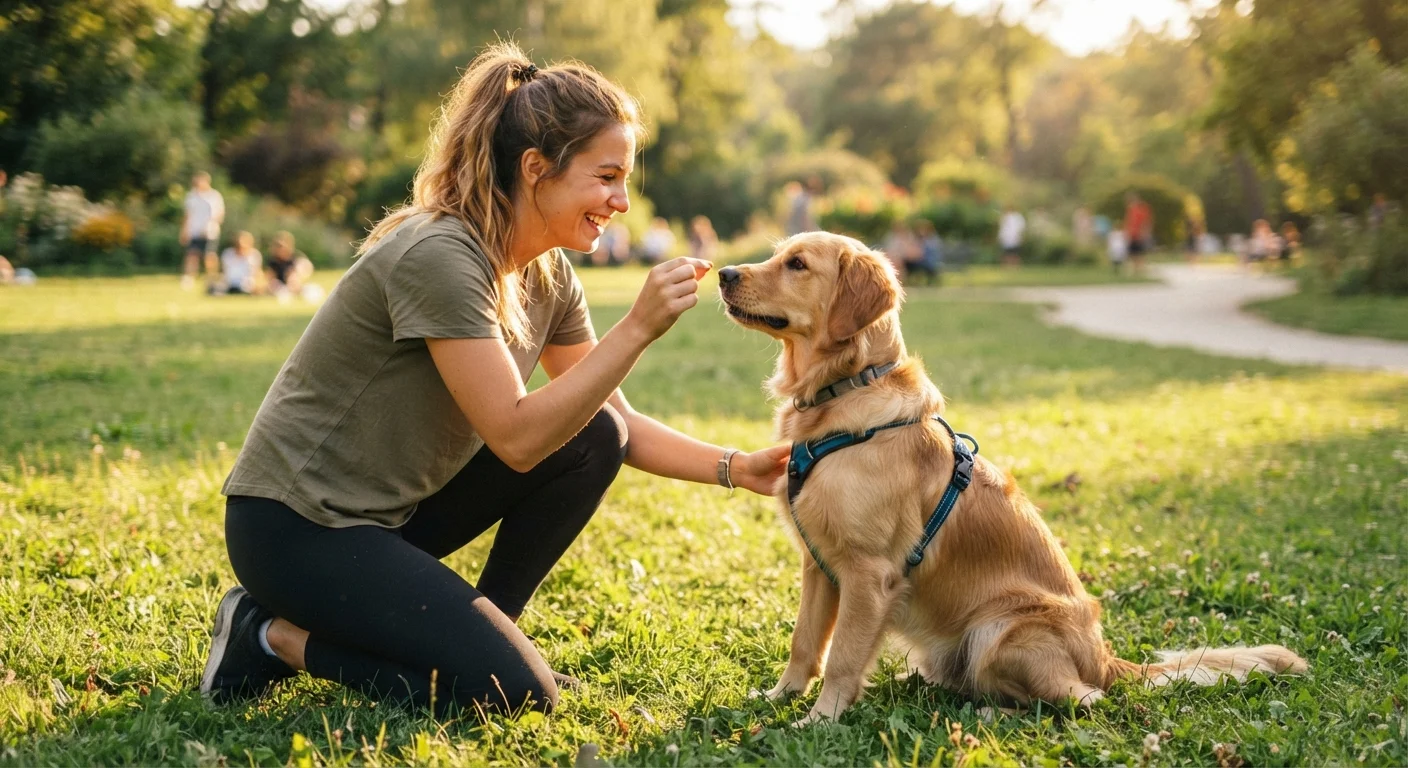
Photo credit: SkripTee.com | Search. Explore. Learn.
In this article
Continuous vs. variable reinforcement explained — and why fading treat frequency correctly is key to behaviours that hold up under real-world conditions.
Key Takeaways
- Reward every correct response when teaching a brand-new behaviour to build it quickly.
- Gradually reducing treat frequency - called fading - prevents behaviour from disappearing when rewards aren't available.
- Variable reinforcement schedules produce the most durable, real-world-proof behaviours.
- Fading too fast causes behaviours to fall apart; fading too slowly delays real-world reliability.
- Pairing treats with praise helps behaviours hold up even when food rewards aren't on hand.
Why the Timing of Rewards Changes Everything
Most pet owners instinctively reach for a treat the moment their dog sits, their cat touches a target, or their parrot steps up. That impulse is exactly right - but it's only part of the story. When you reward matters, and so does how often. This is what animal behaviorists call a reinforcement schedule, and understanding it is the difference between a behaviour that works at home on a quiet afternoon and one that holds up at the vet, on a busy trail, or when you're distracted.
Think of a reinforcement schedule as a recipe. Change the proportions and you change the outcome - sometimes dramatically. Research on how pets retain new behaviours shows that reward timing and frequency are among the most powerful variables a trainer controls.
Reinforcement Schedules Apply to All Species
While dogs are the most common example, reinforcement schedules work across virtually all trainable companion animals - cats, rabbits, parrots, and even fish have been trained using these principles. The underlying learning mechanisms are broadly conserved across species that can associate actions with outcomes.
Continuous Reinforcement: The Learning Phase
When introducing any new behaviour, continuous reinforcement - rewarding every single correct response - is your most effective tool. It gives your pet clear, immediate feedback: this action earns a good thing. Learning happens faster, confusion is minimised, and your pet builds confidence.
The downside is that continuous reinforcement creates a behaviour that's fragile under real-world conditions. If you always carry treats and your pet always expects one, the behaviour can collapse the moment the treat pouch disappears. This is why continuous reinforcement is a starting point, not a permanent strategy.
~50%
Faster acquisition with continuous reinforcement
Animal learning research consistently shows that continuous reinforcement during the initial learning phase produces significantly faster acquisition compared to intermittent schedules from the start.
Slowest
Extinction rate under variable ratio schedules
Among the four primary reinforcement schedules studied in operant conditioning research, variable ratio schedules produce the slowest extinction - meaning behaviours maintained this way are the hardest to lose.
Fading Treats: The Bridge to Real-World Reliability
Fading is the deliberate, gradual process of reducing how often you deliver a food reward after a behaviour is already established. Done correctly, it shifts your pet's motivation from "I know a treat is coming" to "a reward might be coming, so I'd better respond." That uncertainty is actually a feature, not a bug.
The key word is gradual. Cutting treats too abruptly - say, rewarding every response one week and almost none the next - causes behaviours to weaken or disappear entirely. A sustainable fade looks more like this: reward 4 out of 5 correct responses for several sessions, then 3 out of 5, then 2, varying which responses earn treats so the pattern feels unpredictable to your pet.
Use a "Jackpot" to Reinforce Outstanding Responses
Occasionally delivering an unexpectedly large reward - several treats at once or an enthusiastic play session - for a particularly clean response can reinvigorate a behaviour and accelerate the fading process. Use jackpots sparingly so they retain their motivational punch.
Variable Reinforcement: The Engine of Durable Behaviour
Once you've begun fading, you're naturally moving toward a variable ratio schedule - the most powerful maintenance schedule available. Instead of a predictable pattern, your pet receives rewards at an average rate that varies from trial to trial. They can't predict which response will earn a treat, so they keep responding consistently.
This is the same psychological mechanism behind games of chance: unpredictable rewards generate persistent behaviour. For your pet, it means a "sit" is just as likely to earn a jackpot on the fifth attempt as on the first, which keeps motivation high even as treat frequency drops.
Blending food with non-food rewards - verbal praise, a favourite toy, brief play - also extends reliability. Your pet learns that value comes in many forms, which matters enormously in environments where treats aren't practical. The same principle of consistent, small actions building lasting results applies beyond pets: behavioural science research on habit formation in humans reflects parallel findings.
“Behaviour that has been reinforced on a variable schedule is characteristically persistent. The animal keeps responding because it has learned that a reward is always possible, even if it is not always delivered.”
— B.F. Skinner, Psychologist and pioneer of operant conditioning research
Common Mistakes and How to Avoid Them
Even well-intentioned owners run into predictable pitfalls. The most common: fading treats too fast after a single good session, or never fading at all because the behaviour "seems solid." Both create fragile outcomes.
- Fading too fast: The behaviour weakens under distraction or when treats aren't visible. Solution - slow the fade and add variability before reducing further.
- Never fading: Your pet becomes treat-dependent. Solution - begin a gradual fade as soon as the behaviour is consistent across several sessions.
- Predictable patterns: Rewarding every third response teaches your pet to wait out the misses. Solution - vary which responses earn rewards so the schedule feels truly random.
Understanding these nuances takes some practice, but the investment pays off in behaviours that genuinely hold up when it counts. For a deeper look at structuring your sessions effectively, see how session length and reward variety affect long-term learning.
This article is for general educational purposes only and is not a substitute for guidance from a certified professional animal trainer or veterinary behaviourist.
Frequently Asked Questions

Author
Pets Editorial Team
Pets Editorial Team is the collective byline for our editorial team and contributor network. Articles published under this byline or an editorial pen name are researched, written, and reviewed according to our editorial standards for clarity, consistency, and independence before publication.
View all articles →