
Why Your Cat Ignores Training Cues - And What to Try Instead
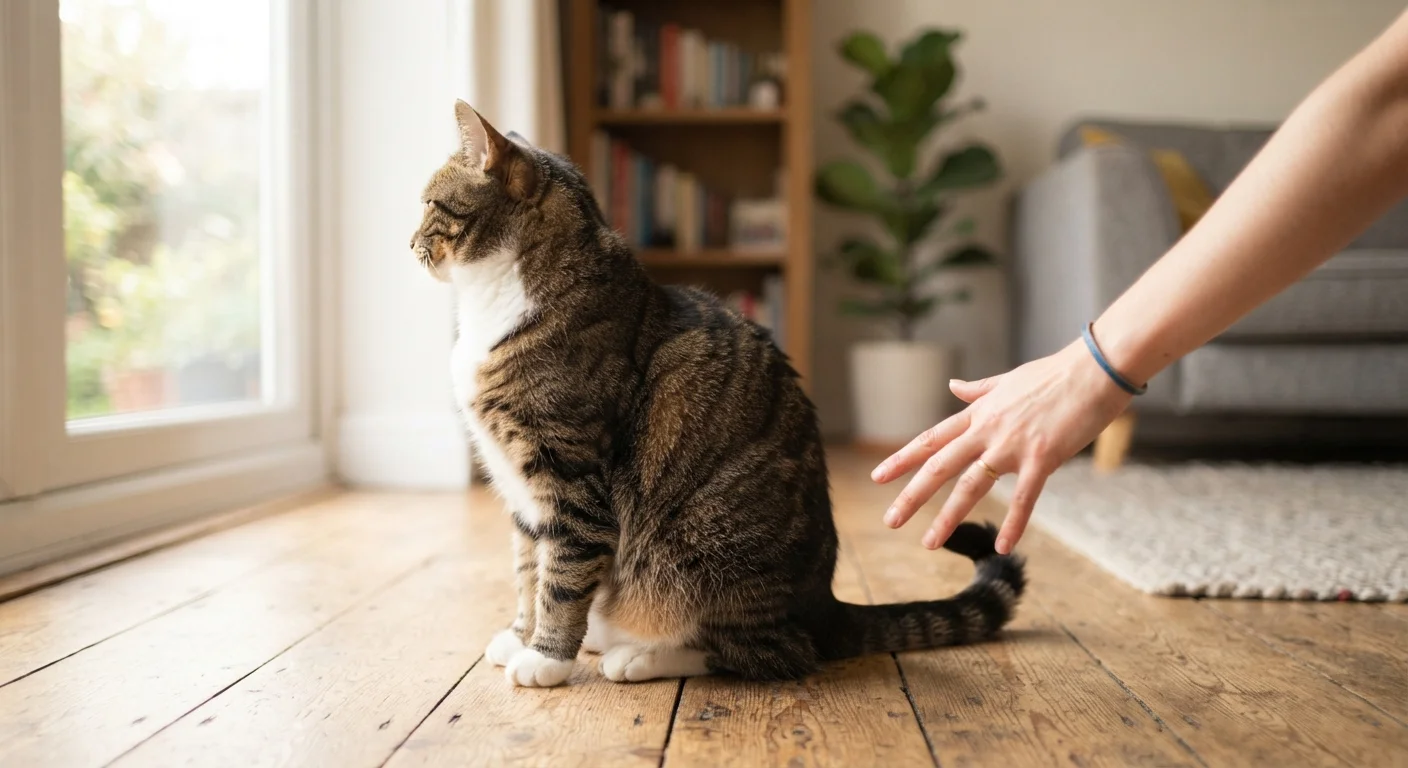
Photo credit: SkripTee.com | Search. Explore. Learn.
In this article
Cats can and do learn, but they respond to different motivators than dogs. Understand feline learning patterns to adjust your approach.
Key Takeaways
- Cats learn through operant conditioning just like dogs, but they are highly sensitive to motivation and timing.
- Using the wrong reward, wrong timing, or overly long sessions are the most common reasons training fails.
- Short, low-pressure sessions of two to five minutes tend to produce better results with most cats.
- Hunger level, environment, and your cat's arousal state all affect whether learning can occur.
- Positive reinforcement - never punishment - is the only evidence-backed method for training cats.
Why Cats Seem to Ignore You - And Why That's Not the Whole Story
The idea that cats are untrainable is one of the most persistent myths in pet ownership. Cats are fully capable of learning new behaviors - research in animal cognition confirms they respond to the same principles of operant conditioning that underpin training in dogs, dolphins, and many other species. The difference is not ability; it's motivation and context.
Unlike dogs, who evolved alongside humans as cooperative working partners, cats domesticated themselves largely on their own terms. They retained the independent, solitary nature of their wild ancestors. That means your cat isn't ignoring your cue because it lacks the cognitive wiring to understand - it may simply see no compelling reason to comply right now. Understanding that distinction is the first step to training that actually works.
1-2 sec
Effective reward timing window for cats
Animal learning research consistently shows that the association between a behavior and its consequence weakens dramatically when delivery is delayed beyond one to two seconds.
2-5 min
Recommended cat training session length
Veterinary behavior practitioners and certified applied animal behaviorists generally recommend very short sessions to match a cat's natural attention and motivation limits.
The Most Common Training Mistakes Cat Owners Make
Most failed feline training attempts come down to a handful of predictable errors. The good news is that each one is correctable once you know what to look for.
Using dog-focused training logic on a cat - expecting the same social motivation, attention span, and eagerness to please.
Why it happens: Most owners learn training concepts from dog-centric resources, and the popular image of training is built around a dog's strong social drive and desire for handler approval.
Training when the cat isn't hungry, reducing the reinforcing value of food rewards to near zero.
Why it happens: Owners often attempt training after meals or leave food available free-choice throughout the day, not realizing that a satiated cat has little incentive to work for treats.
Delaying the reward by even a few seconds, breaking the timing window that links behavior to consequence.
Why it happens: Reaching for a treat bag or fumbling with a clicker after the cat performs a behavior is easy to do, but the association between action and reward is lost almost immediately in cats.
Running sessions that are too long, causing the cat to disengage, leave, or become irritable.
Why it happens: Owners mistake a cat walking away for defiance rather than recognizing it as a normal sign that the cat's attention and motivation are exhausted.
Training in a distracting environment before the behavior is well established, overwhelming the cat's ability to focus.
Why it happens: Owners naturally want to demonstrate what their cat can do in lively settings, but generalization - performing a learned behavior in new contexts - requires deliberate, incremental practice.
Repeating the cue multiple times when the cat doesn't respond, teaching the cat that the cue means nothing.
Why it happens: Repeating "sit, sit, sit" feels natural when a cat doesn't respond immediately, but it conditions the cat to tune out the first presentation of any cue.
This article is for general informational purposes only and is not a substitute for advice from a certified veterinary behaviorist or applied animal behaviorist. If your cat displays sudden behavior changes, consult your veterinarian to rule out underlying health issues before beginning any training program.
Building a Training Relationship That Lasts
Effective cat training is less about commands and more about building a consistent, low-stress communication loop. When your cat reliably predicts that engaging with you leads to something genuinely good - a preferred treat, a short play session, a moment of calm attention - it builds the motivational foundation that makes learning possible.
Punishment Has No Place in Cat Training
Spraying water, yelling, or physically correcting a cat does not teach the desired behavior - it teaches your cat to fear or avoid you. Veterinary behaviorists consistently advise against any aversive technique with cats, as it damages trust without producing reliable learning. If a behavior is unsafe or destructive, redirect and reinforce an incompatible behavior instead, and consult a veterinary behaviorist if you're struggling.
Start with simple, high-value behaviors like targeting (touching the nose to your finger) or coming when called. These create early wins that reinforce both the cat's confidence and your own. As behaviors become reliable in one setting, gradually introduce new locations and mild distractions. Patience and consistency matter far more than frequency or duration.
Don't Train a Stressed or Unwell Cat
A cat that is hiding, vocalizing unusually, or showing appetite changes may be experiencing pain or illness, not stubbornness. Attempting training sessions during this time is unlikely to succeed and may worsen stress. Rule out any health concerns with your veterinarian before starting or resuming a training program.
If you're navigating a household where both cats and dogs need training, understanding species differences becomes even more important - our guide on managing multi-pet households explores how to meet each animal's needs without conflict. And if you've been relying on training approaches you read elsewhere, it's worth reviewing common training myths to clear out any assumptions that might be working against you.

Author
Pets Editorial Team
Pets Editorial Team is the collective byline for our editorial team and contributor network. Articles published under this byline or an editorial pen name are researched, written, and reviewed according to our editorial standards for clarity, consistency, and independence before publication.
View all articles →