
Insulation Explained: Types, R-Values, and Where Each One Belongs
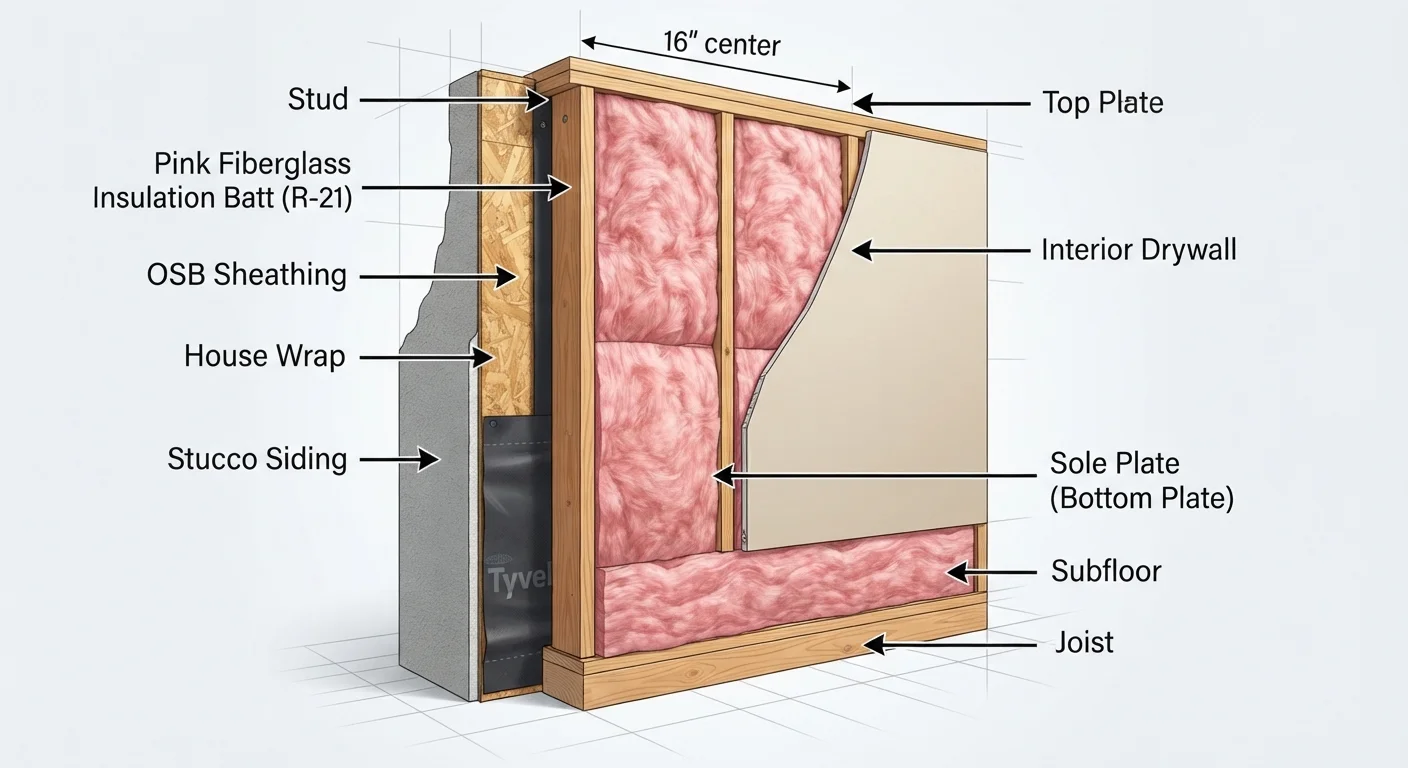
Photo credit: SkripTee.com | Search. Explore. Learn.
In this article
Insulation terminology can be confusing. This reference covers the main types, how R-values work, and where each material is typically used.
How R-Values Work
Every insulation product carries an R-value - a rating that measures resistance to heat flow. The higher the R-value, the greater the material's ability to slow thermal transfer. R-values are additive: two layers of R-13 batts together provide approximately R-26.
Required R-values vary by climate zone and location in the home. The U.S. Department of Energy publishes zone-specific recommendations - for example, attic insulation in colder northern climates is commonly recommended at R-49 to R-60, while the same space in a mild southern climate may call for R-30 to R-38. Local building codes may set minimums for new construction and major renovation projects; always verify requirements with your local building department before beginning work.
| Typical attic R-value target (cold climates) | R-49 to R-60 (U.S. Department of Energy climate zone recommendations) |
| Typical attic R-value target (mild climates) | R-30 to R-38 (U.S. Department of Energy climate zone recommendations) |
| Closed-cell spray foam R-value per inch | ~R-6 to R-7 (General industry range; varies by product) |
| Fiberglass batt R-value range | R-11 to R-38 (Varies by thickness and product type) |
| Cellulose loose-fill R-value per inch | ~R-3.2 to R-3.8 (General industry range) |
R-value alone doesn't tell the whole story. Air sealing gaps and thermal bridging (heat escaping through framing members rather than insulation) can significantly undercut an insulation system's real-world performance, even when the rated R-value is adequate.
Main Insulation Types and Where They're Used
Different materials suit different applications. Below is a reference overview of the most common types found in U.S. residential construction.
R-Value
A measure of an insulation material's resistance to heat flow. Higher R-values indicate greater insulating power. Required levels vary by climate zone and building location.
Thermal Bridging
Heat transfer that occurs through structural elements like wood studs or metal framing rather than through the insulation itself, reducing the effective performance of the insulation system.
Vapor Retarder
A material that slows the movement of moisture vapor through walls and ceilings. Closed-cell spray foam functions as both an insulator and a vapor retarder.
Air Sealing
The process of closing gaps, cracks, and penetrations in the building envelope to reduce uncontrolled air movement. Effective air sealing works in tandem with insulation to improve energy performance.
Dense-Pack
A blown-in insulation technique where cellulose or fiberglass is injected at high density into enclosed cavities, minimizing settling and improving air resistance.
Polyisocyanurate (Polyiso)
A type of rigid foam board insulation with one of the highest R-values per inch among common insulation materials, often used on exterior walls and roofing assemblies.
Fiberglass Batts and Rolls
The most widely installed type in existing homes, fiberglass batts fit between standard-spaced wall studs (16" or 24" on center) and floor joists. They offer R-values roughly between R-11 and R-38 depending on thickness, are relatively affordable, and require no special equipment to install. However, gaps and compression sharply reduce effectiveness, making careful installation important.
Blown-In (Loose-Fill) Insulation
Blown cellulose or fiberglass is pumped into attic floors, enclosed wall cavities, and hard-to-reach spaces using pneumatic equipment. Cellulose (made largely from recycled paper) and fiberglass loose-fill both conform well to irregular shapes, making them suited to attic retrofits where coverage consistency matters. Cellulose typically achieves around R-3.2 to R-3.8 per inch; fiberglass loose-fill around R-2.2 to R-2.7 per inch.
Spray Polyurethane Foam (SPF)
Spray foam comes in two main forms. Open-cell foam is softer, vapor-permeable, and provides approximately R-3.5 to R-3.7 per inch - commonly applied in interior wall cavities and under floors. Closed-cell foam is denser, acts as both an insulator and a vapor retarder, and reaches approximately R-6 to R-7 per inch, making it useful for tight spaces, rim joists, and applications where moisture control is critical. Spray foam application requires professional installation and proper safety precautions.
Rigid Foam Board
Rigid panels of expanded polystyrene (EPS), extruded polystyrene (XPS), or polyisocyanurate (polyiso) are used on exterior walls, under slabs, and in basement walls where space is limited. Polyiso offers the highest R-value per inch of the three (approximately R-6 to R-6.5), though its performance can decrease in very cold temperatures. Rigid foam often requires a fire-rated covering such as drywall when installed indoors.
Mineral Wool (Rockwool/Slag Wool)
Mineral wool batts and loose-fill are made from volcanic rock or industrial slag. They are naturally fire-resistant, water-repellent, and offer good sound attenuation - making them a common choice for party walls, utility rooms, and areas where fire separation is a concern. R-values are comparable to fiberglass batts.
Choosing the Right Insulation for Each Location
The table below summarizes typical applications by location in the home. Consult a qualified insulation contractor or energy auditor to assess your specific conditions before selecting materials.
| Location | Commonly Used Types | Notes |
|---|---|---|
| Attic floor | Blown cellulose or fiberglass, batts | Prioritize air sealing first |
| Exterior walls (new build) | Batts, closed-cell spray foam, rigid board | Depth of cavity limits options |
| Exterior walls (retrofit) | Blown-in dense-pack cellulose or fiberglass | Minimally invasive for existing homes |
| Basement walls | Rigid foam board, closed-cell SPF | Moisture management is critical |
| Crawl space | Rigid foam, closed-cell SPF, batts | Varies by conditioned vs. vented design |
| Rim joists | Closed-cell SPF, rigid foam cut-and-cobble | Common air-leakage point |
Permits and Professional Installation
Many insulation projects - especially those involving spray polyurethane foam or changes to conditioned spaces - may require permits or licensed contractors depending on your local jurisdiction. Improper installation can affect moisture balance, indoor air quality, and fire safety. Check with your local building department before starting any significant insulation work.
If you are planning a significant insulation project - particularly one involving spray foam, structural modifications, or work in conditioned crawl spaces - consult a licensed contractor and check whether permits are required in your jurisdiction. Improper installation can affect indoor air quality, moisture balance, and fire safety.
This article is for general informational purposes only and does not constitute construction, engineering, or professional contracting advice. Always verify local building code requirements and consult qualified professionals for your specific project.

Author
Real Estate Editorial Team
Real Estate Editorial Team is the collective byline for our editorial team and contributor network. Articles published under this byline or an editorial pen name are researched, written, and reviewed according to our editorial standards for clarity, consistency, and independence before publication.
View all articles →