
DIY Car Maintenance vs. Taking It to a Mechanic
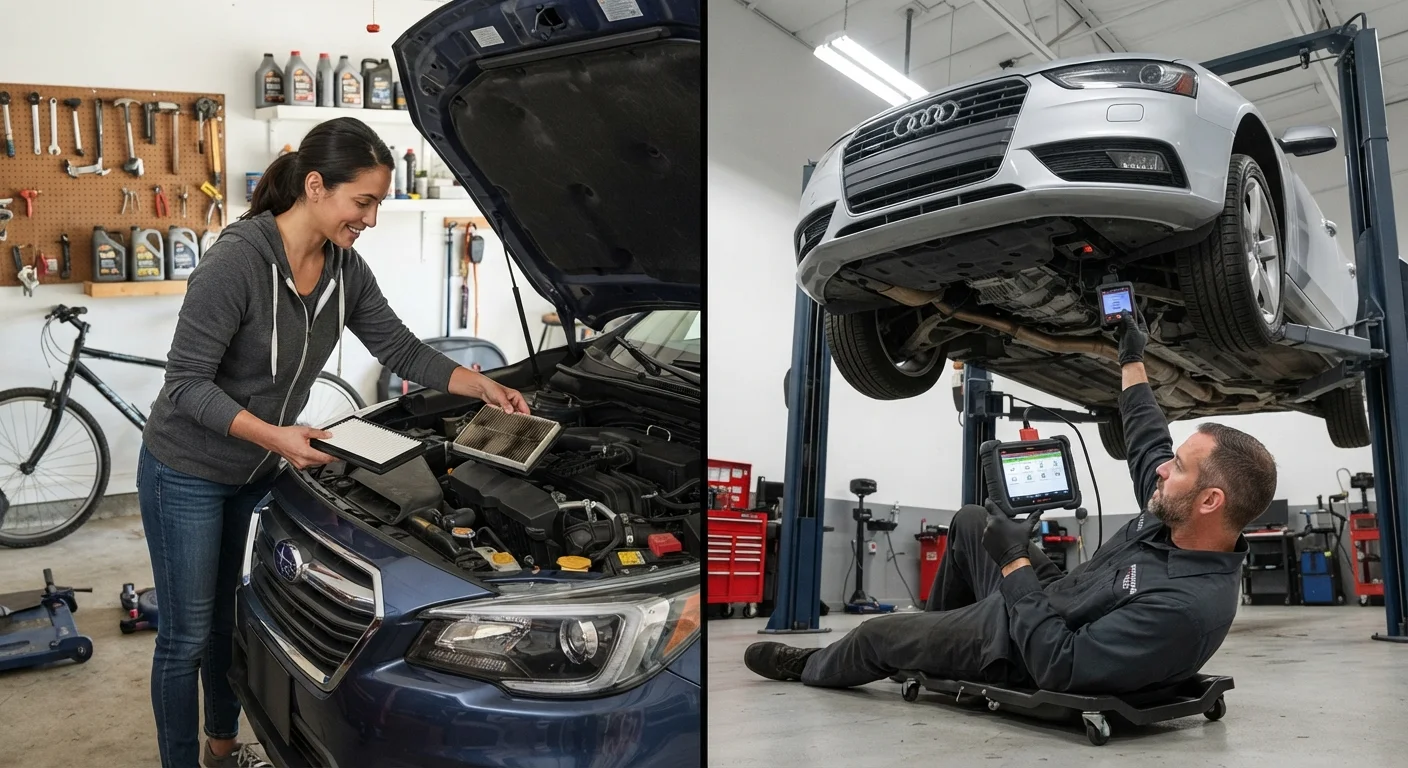
Photo credit: SkripTee.com | Search. Explore. Learn.
In this article
Some tasks are safe for home mechanics; others require professional tools and expertise. Here's a balanced look at where the line sits for everyday drivers.
Key Takeaways
- Many routine tasks like air filter swaps and wiper replacements are safely done at home with basic tools.
- Brake repairs, suspension work, and advanced diagnostics typically require professional expertise and equipment.
- Doing a job incorrectly can cost significantly more than having a professional do it from the start.
- Your owner's manual is the most reliable guide for service intervals and specifications.
- Safety-critical systems should almost always be serviced by a qualified mechanic.
Reduces labor costs on simple, repetitive tasks
Labor charges can represent the majority of a service bill for tasks like air filter or wiper replacements. Doing these yourself eliminates that cost entirely when you supply your own time.
Builds practical knowledge of your vehicle
Regularly checking fluids and inspecting accessible components helps you notice changes - unusual wear, leaks, or low levels - before they become larger problems.
Convenient for straightforward, time-sensitive checks
Topping off washer fluid or checking tire pressure doesn't require a service appointment. Handling these promptly at home keeps your vehicle in better routine condition.
Gives you control over parts quality
When you source your own parts, you can verify they meet manufacturer specifications, rather than relying on whatever a shop has in stock at a given time.
Mistakes on safety systems carry serious consequences
An error on brakes, steering, or suspension doesn't just risk a repair bill - it can compromise vehicle control. Safety-critical jobs leave very little margin for learning-by-doing.
Requires tools that may cost more than the job
Some DIY jobs require torque wrenches, OBD-II scanners, or specialty sockets. For tasks you'll only do once, buying the correct tools can exceed the cost of professional labor.
Incorrect work may void warranty coverage
On vehicles still under manufacturer or extended warranty, some DIY repairs - particularly if done without documented use of approved parts and procedures - can complicate warranty claims.
Difficult to diagnose accurately without professional equipment
Consumer-grade diagnostic scanners read fault codes but rarely provide the deeper data a professional scan tool offers. Replacing parts based on incomplete diagnostics is a common and costly mistake.
Time investment is often underestimated
A job that takes a shop technician 45 minutes with a lift and air tools can take an inexperienced home mechanic several hours - or longer if complications arise.
Why This Question Matters
Car maintenance isn't one-size-fits-all. Some tasks are genuinely within reach for any careful driver armed with a decent how-to guide and a few basic tools. Others carry real risks if performed without proper training, equipment, or understanding of how interconnected vehicle systems work.
Getting this distinction right matters financially and, more importantly, for safety. A poorly installed brake pad or an incorrectly torqued wheel lug nut aren't inconveniences - they're hazards. Before deciding what to tackle at home, it helps to have a clear framework. See also why preventive maintenance timing matters for context on how service schedules work.
What DIY Maintenance Does Well
The case for handling some maintenance yourself is legitimate - provided the task is appropriate.
Reduces labor costs on simple, repetitive tasks
Labor charges can represent the majority of a service bill for tasks like air filter or wiper replacements. Doing these yourself eliminates that cost entirely when you supply your own time.
Builds practical knowledge of your vehicle
Regularly checking fluids and inspecting accessible components helps you notice changes - unusual wear, leaks, or low levels - before they become larger problems.
Convenient for straightforward, time-sensitive checks
Topping off washer fluid or checking tire pressure doesn't require a service appointment. Handling these promptly at home keeps your vehicle in better routine condition.
Gives you control over parts quality
When you source your own parts, you can verify they meet manufacturer specifications, rather than relying on whatever a shop has in stock at a given time.
Tasks commonly suited to DIY include: replacing engine air filters, swapping wiper blades, checking and topping off fluids (oil, coolant, washer fluid), replacing cabin air filters, and changing a flat tire using a spare. These jobs are well-documented, reversible if done imperfectly, and require only basic tools. Your owner's manual specifies the correct parts and intervals for most of these tasks - consult it before starting any job.
Where DIY Breaks Down
The honest downside of DIY maintenance is that the line between straightforward and dangerous isn't always obvious - especially to someone newer to vehicle ownership.
Mistakes on safety systems carry serious consequences
An error on brakes, steering, or suspension doesn't just risk a repair bill - it can compromise vehicle control. Safety-critical jobs leave very little margin for learning-by-doing.
Requires tools that may cost more than the job
Some DIY jobs require torque wrenches, OBD-II scanners, or specialty sockets. For tasks you'll only do once, buying the correct tools can exceed the cost of professional labor.
Incorrect work may void warranty coverage
On vehicles still under manufacturer or extended warranty, some DIY repairs - particularly if done without documented use of approved parts and procedures - can complicate warranty claims.
Difficult to diagnose accurately without professional equipment
Consumer-grade diagnostic scanners read fault codes but rarely provide the deeper data a professional scan tool offers. Replacing parts based on incomplete diagnostics is a common and costly mistake.
Time investment is often underestimated
A job that takes a shop technician 45 minutes with a lift and air tools can take an inexperienced home mechanic several hours - or longer if complications arise.
If you're building your mechanical knowledge from the ground up, starting with the fundamentals is the smart move before attempting anything beyond basic fluid checks. And be aware that some jobs that look simple on video tutorials - like changing brake pads - involve torque specifications, bedding-in procedures, and safety checks that are easy to overlook.
~35%
Share of a typical repair bill attributed to labor
Industry estimates from automotive service organizations suggest labor regularly accounts for a substantial portion of repair costs, making it the primary driver of DIY savings on simple jobs.
3-4x
Potential cost multiplier from a misdiagnosed repair
Automotive consumer advocates note that replacing the wrong component based on a misread fault code - a common DIY error - can multiply total repair costs significantly compared to accurate professional diagnosis.
Tasks That Should Go to a Professional
Certain categories of work are best left to qualified mechanics, regardless of your comfort level with tools:
- Brake system work - pads, rotors, calipers, and brake fluid flushes involve safety-critical precision.
- Suspension and steering components - alignment, ball joints, and tie rods affect vehicle control and require specialized equipment to set correctly.
- Transmission service - especially on modern automatic and CVT (continuously variable transmission) units, which have narrow fluid tolerances.
- Electrical diagnostics - modern vehicles have dozens of interconnected control modules; misreading a fault code can lead to unnecessary part replacements.
- Timing belt or chain replacement - engine damage from an incorrect installation can be severe and expensive.
- Airbag system work - these systems carry real injury risk if disturbed incorrectly.
This isn't an exhaustive list. A useful rule: if the job requires the vehicle to be safely supported off the ground, involves pressurized systems, or directly affects braking or steering, a mechanic should be doing it.
When in Doubt, Get a Second Opinion
If a mechanic recommends a repair that surprises you, you're entitled to ask for a written estimate and seek a second opinion before authorizing work. Reputable shops expect this. Understanding what your vehicle actually needs - versus what's upsold - is part of being an informed vehicle owner. Resources like your owner's manual can help you verify whether a recommended service is genuinely due.
Making the Decision on Any Given Job
Before starting a task, run through three honest questions: Do I understand exactly what this job involves, including how to verify it's done correctly? Do I have the right tools - not approximations, but the actual specified tools? And what's the realistic consequence if I make an error?
If the answer to any of these gives you pause, the cost of professional labor is almost certainly less than the cost of correcting a mistake. The myths that cost drivers money often involve overconfidence in DIY tasks that seem simpler than they are. A blended approach - learning the low-risk jobs, and building a relationship with a trustworthy mechanic for the rest - is what most experienced drivers settle on over time.

Author
Autos Editorial Team
Autos Editorial Team is the collective byline for our editorial team and contributor network. Articles published under this byline or an editorial pen name are researched, written, and reviewed according to our editorial standards for clarity, consistency, and independence before publication.
View all articles →