
Whole Foods vs. Ultra-Processed Foods: What the Evidence Says
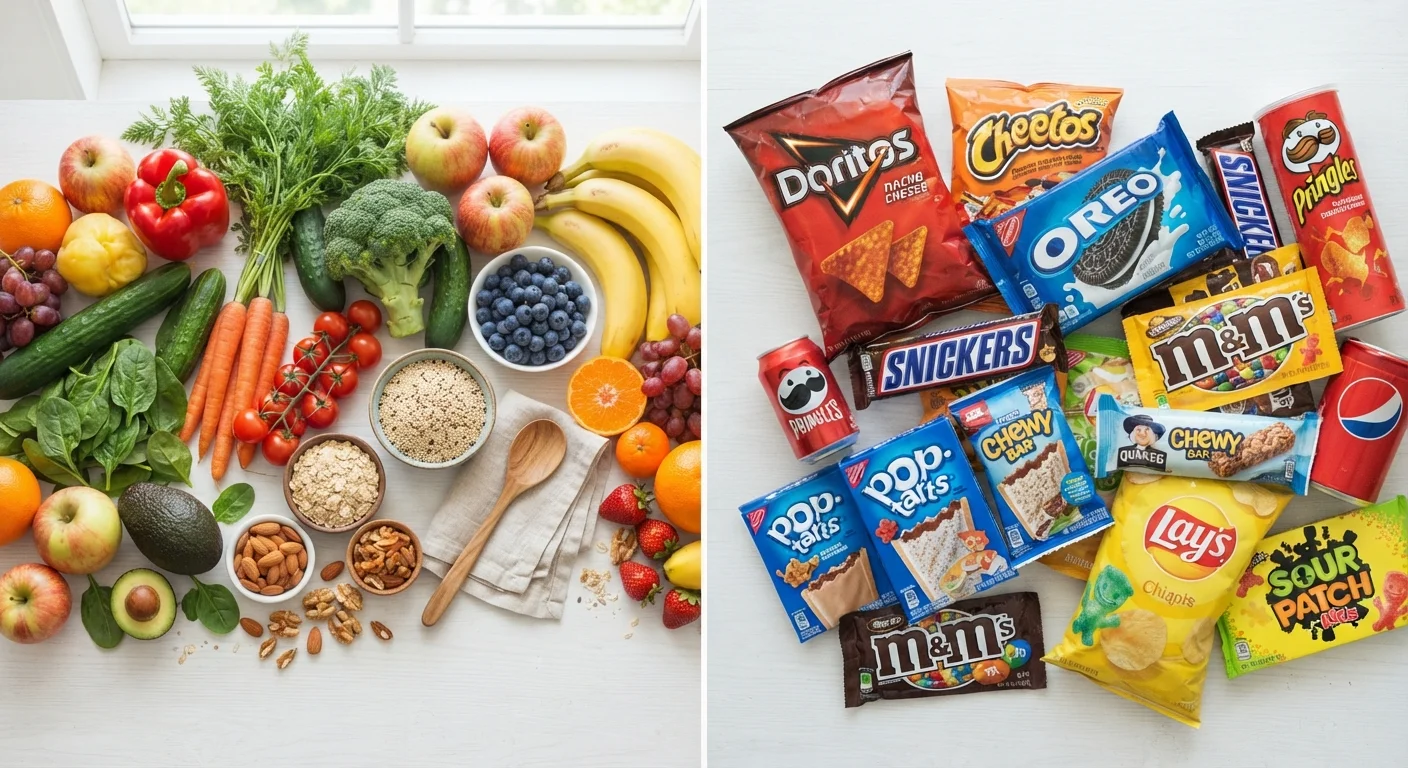
Photo credit: SkripTee.com | Search. Explore. Learn.
In this article
A factual look at how whole foods and ultra-processed foods differ in nutritional quality and what research suggests about long-term dietary patterns.
Key Takeaways
- Ultra-processed foods are defined by industrial formulation, not simply by ingredient count or calorie density.
- Large observational studies associate higher ultra-processed food intake with increased risks of several chronic conditions.
- Whole foods provide fiber, phytonutrients, and food matrix benefits that isolated nutrients in supplements rarely replicate.
- A balanced dietary pattern can accommodate occasional processed foods without undermining overall nutritional quality.
- Food labeling literacy helps consumers identify ultra-processed products and make more informed everyday choices.
How Are These Two Categories Defined?
The term whole foods refers to foods that are unprocessed or minimally processed - vegetables, fruits, legumes, whole grains, nuts, seeds, eggs, and plain dairy. They retain most of their original nutritional structure and contain few or no added ingredients.
Ultra-processed foods (UPF) are defined most rigorously by the NOVA classification system, developed by Brazilian nutrition researchers. NOVA groups foods into four categories based on the nature and extent of processing. Ultra-processed products (NOVA Group 4) are characterized by industrial formulations containing substances extracted from foods - such as hydrogenated fats, modified starches, or protein isolates - along with additives like emulsifiers, flavor enhancers, and artificial colors rarely used in home cooking. Think packaged snacks, ready-to-eat meals, reconstituted meat products, and many sweetened beverages.
It's worth noting that not all processed foods are ultra-processed. Canned tomatoes, pasteurized milk, and frozen plain vegetables are processed but retain much of their nutritional integrity. The NOVA framework distinguishes these from products engineered primarily for palatability and extended shelf life. For a deeper look at how nutrition evidence is evaluated, see our guide to separating solid nutrition evidence from diet trends.
What Does the Research Show?
The body of observational evidence linking ultra-processed food consumption to health outcomes has grown substantially. Several large cohort studies - including analyses from the NutriNet-Santé study in France and the UK Biobank - have found associations between higher UPF intake and elevated risks of cardiovascular disease, type 2 diabetes, certain cancers, depression, and all-cause mortality. Importantly, these associations often hold even after researchers control for overall dietary quality metrics like sugar, sodium, and saturated fat intake, suggesting that processing itself - not just poor nutrient composition - may play a role.
A 2024 umbrella review published in The BMJ synthesized evidence from dozens of meta-analyses and found consistent associations between UPF consumption and adverse health outcomes across multiple disease categories. However, because most of this research is observational, causation cannot be firmly established. Confounding factors - such as socioeconomic status, overall lifestyle, and dietary reporting errors - remain legitimate concerns that scientists continue to address.
~57%
Share of US adult calories from ultra-processed foods
A nationally representative analysis published in BMJ Open estimated that ultra-processed foods contribute roughly 57% of daily caloric intake among US adults.
32%
Higher cardiovascular disease risk linked to high UPF intake
A large cohort study published in The BMJ found that the highest ultra-processed food consumers had approximately 32% higher risk of cardiovascular disease than the lowest consumers.
10+ servings
Daily UPF servings in high-consumption groups
Research tracking dietary patterns in several European cohorts found that high-intake groups often consumed more than 10 ultra-processed food servings per day.
Whole food dietary patterns, by contrast, are consistently associated with better health markers. The Mediterranean and DASH dietary patterns - both emphasizing whole foods - have among the strongest evidence bases in nutrition science for cardiovascular and metabolic health benefits. For context on how different food components interact, our overview of saturated vs. unsaturated fats is a useful companion read.
Nutritional Differences at a Glance
Beyond research associations, the nutritional contrast between whole foods and ultra-processed foods is measurable and meaningful across several dimensions.
| Criterion | Whole Foods | Ultra-Processed Foods |
|---|---|---|
| Fiber content | Naturally high; intact plant fiber | Often low or removed during processing |
| Added sugars & sodium | Minimal to none | Frequently high; used for flavor and preservation |
| Micronutrient density | Rich in vitamins, minerals, phytonutrients | Often low; some are fortified synthetically |
| Additives & emulsifiers | Absent or minimal | Common; include stabilizers, colorants, flavor agents |
| Food matrix integrity | Preserved; affects digestion and satiety | Disrupted by industrial processing |
| Satiety response | Generally stronger per calorie | Often engineered for palatability over satiety |
| Shelf stability | Variable; often shorter | Designed for extended shelf life |
One important concept is the food matrix - the physical and chemical structure of a food that influences how its nutrients are absorbed and how the body responds. Eating an apple, for example, delivers fiber, water, and sugars within a cellular structure that slows digestion differently than drinking the equivalent sugar in a flavored beverage. This matrix effect is an active area of nutrition research and helps explain why isolated nutrients in supplements often fail to replicate the benefits of eating whole foods. You can explore how this applies to protein in our article on protein quality and amino acid completeness.
Practical Takeaways for Everyday Eating
Nutrition science doesn't support an all-or-nothing approach. Ultra-processed foods are deeply embedded in modern food environments, and rigid elimination is neither realistic nor necessary for most people. What the evidence does support is shifting the overall dietary pattern toward whole and minimally processed foods as the foundation of daily eating.
Some practical strategies that align with current dietary guidance include:
- Using ingredient lists to identify products with additives like emulsifiers, artificial flavors, or modified starches as primary signals of ultra-processing.
- Prioritizing whole grains, legumes, vegetables, and fruits as dietary staples rather than occasional additions.
- Recognizing that minimally processed convenience foods - plain canned beans, frozen vegetables, plain yogurt - can anchor a nutrient-dense diet without requiring extensive meal preparation.
- Being aware that marketing terms like "natural" or "fortified" don't indicate a food is minimally processed.
What "Processed" Actually Means on Labels
Food labeling in the US does not use the NOVA classification system, so terms like "minimally processed" or "lightly processed" have no regulated legal definition. Reading ingredient lists remains the most reliable way to assess processing level. Foods with short ingredient lists featuring recognizable whole-food ingredients generally align with lower NOVA categories, while long lists containing chemical-sounding additives are often signals of ultra-processing.
For a broader look at how common nutrition habits are sometimes misapplied, our article on where popular nutrition advice goes wrong offers useful perspective. And if you're building a foundational understanding of food and nutrients, the Nutrition Basics hub is a good starting point.
This article is for general informational and educational purposes only and is not a substitute for professional medical or dietary advice. Consult a qualified healthcare provider or registered dietitian for guidance specific to your individual health needs.

Author
Health Editorial Team
Health Editorial Team is the collective byline for our editorial team and contributor network. Articles published under this byline or an editorial pen name are researched, written, and reviewed according to our editorial standards for clarity, consistency, and independence before publication.
View all articles →