
Driving Safely Around Large Trucks and Commercial Vehicles
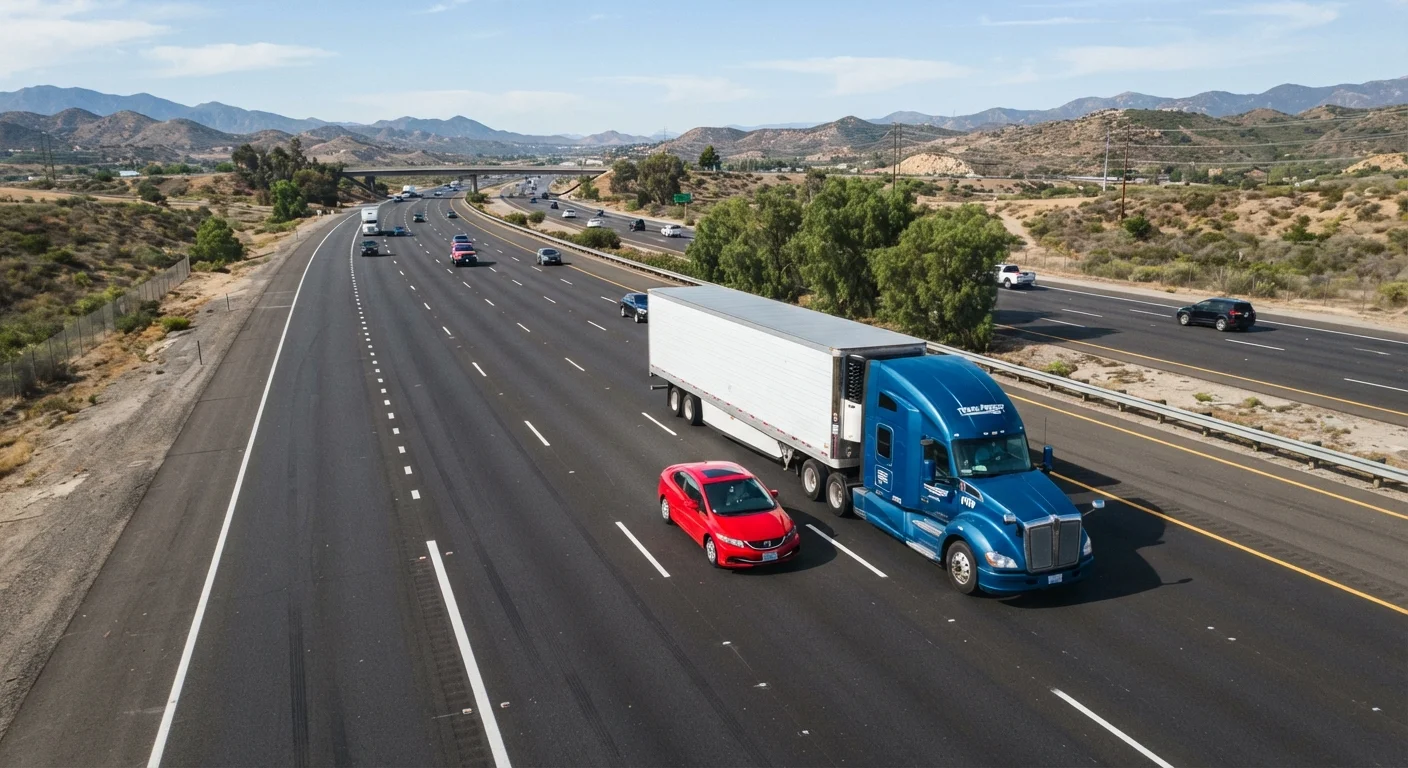
Photo credit: SkripTee.com | Search. Explore. Learn.
In this article
Trucks have wide blind spots, longer braking distances, and different turning arcs. Learn the spacing and positioning rules that reduce risk near HGVs.
Key Takeaways
- Large trucks have four significant blind spots where drivers become completely invisible to the truck operator.
- A fully loaded commercial truck traveling at highway speed can take nearly twice the stopping distance of a passenger car.
- Passing quickly and completely - rather than lingering alongside - is the safest way to move past a large truck.
- Wide right turns by large trucks require passenger vehicles to hold back, not pull forward.
- Wind buffeting and trailer sway can affect your vehicle even when a truck appears to be under control.
Why Large Trucks Behave Differently Than Passenger Vehicles
Commercial trucks - including semi-trucks, tractor-trailers, and large delivery vehicles - operate under entirely different physical constraints than the cars most drivers are used to. A fully loaded 18-wheeler can weigh up to 80,000 pounds, compared to roughly 4,000 pounds for an average passenger car. That mass has direct consequences for stopping distance, turning radius, and how much the driver can see around the vehicle.
Understanding these differences isn't about fearing large trucks. Professional truck drivers are among the most trained operators on the road. The risk arises when passenger vehicle drivers don't account for how trucks move - and position themselves accordingly. This is part of a broader skillset covered in our complete guide to safe driving in all conditions.
Trucks Are Piloted by Professionals
Commercial truck drivers in the U.S. hold a Commercial Driver's License (CDL), which requires additional testing, medical certification, and ongoing training. Understanding truck limitations is about complementing their skill - not compensating for incompetence. The hazards described here are physical constraints, not driver errors.
The Four Blind Spots Every Driver Should Know
Federal safety guidance identifies four primary no-zones around large trucks - areas where the truck driver has little or no visibility of surrounding vehicles:
- Directly in front: Roughly 20 feet ahead of the cab. The elevated seating position creates a blind zone close to the truck's bumper.
- Directly behind: Approximately 30 feet behind the trailer. Unlike passenger cars, trucks have no rear-view mirror - the driver relies entirely on side mirrors.
- Right side: The largest blind spot, extending from the cab door diagonally back across two or more lanes. If you can't see the driver's face in their mirror, they almost certainly can't see you.
- Left side: A smaller but still significant blind zone running from mid-cab to the rear of the trailer.
The practical rule: if you can't see the truck driver's mirror, you're in a blind spot. Move through these zones quickly rather than cruising within them.
Spacing, Following Distance, and Passing
Following distance matters more around trucks than in almost any other driving scenario. At highway speeds, a loaded truck may need 40 percent or more additional stopping distance compared to a passenger car. If you're tailgating a truck and it brakes suddenly, you have almost no margin. Our article on why following distance is one of the most underrated safety margins explains the mechanics in detail.
When passing a large truck, the goal is to move through the transaction decisively:
- Check your mirrors and confirm no vehicles are in your path ahead.
- Signal clearly and accelerate to pass - don't match the truck's speed alongside it.
- Complete the pass and return to your lane only when you can see the full front of the truck in your rear-view mirror.
- Avoid cutting in sharply - trucks require significant distance to respond to sudden lane changes ahead of them.
Right Turns, Intersections, and the Squeeze Hazard
One of the most common and dangerous misunderstandings involves large trucks making right turns. To complete a right turn without mounting the curb, truck drivers often swing left first before turning right - a maneuver that uses significantly more road space than passenger drivers expect.
If you're stopped at an intersection alongside a truck signaling a right turn, do not advance. The trailer will swing out and can strike vehicles positioned in what appears to be a clear lane. Wait until the truck has completed its turn before moving.
At roundabouts and complex intersections, large trucks may occupy multiple lanes to navigate safely. Our breakdown of right-of-way rules that confuse even experienced drivers covers yield situations that apply here too.
The Mirror Rule for Truck Visibility
A simple check applies any time you're near a large truck: if you can see the driver's face in their side mirror, they can likely see you. If the mirror reflects only the side of the trailer or you can't spot the driver at all, you're in a blind zone. Adjust your position before the situation requires the truck to react.
Wind, Weather, and Physical Forces Near Large Trucks
Large trucks displace enormous amounts of air. Passing or being passed by a truck at highway speeds can produce a buffeting effect - a push-pull force on your vehicle that may surprise drivers who haven't experienced it before. Keep a firm, steady grip on the wheel and maintain your lane position when passing or being overtaken.
In adverse conditions, these effects intensify. Rain reduces tire grip and can cause trucks to take even longer to stop. Driving in heavy rain amplifies all of the spacing and visibility risks described here - increase your following distance further and reduce your highway speed around trucks in wet conditions.
Strong crosswinds can cause trailer sway - a side-to-side movement of the trailer that may look alarming but is usually corrected by the driver. Maintain your lane and give the truck space rather than braking suddenly or swerving.
This article is for general informational and educational purposes only. Always follow the traffic laws applicable in your state and consult official driver safety resources for jurisdiction-specific guidance.

Author
Autos Editorial Team
Autos Editorial Team is the collective byline for our editorial team and contributor network. Articles published under this byline or an editorial pen name are researched, written, and reviewed according to our editorial standards for clarity, consistency, and independence before publication.
View all articles →