
Fixed vs. Variable Expenses: Understanding the Difference
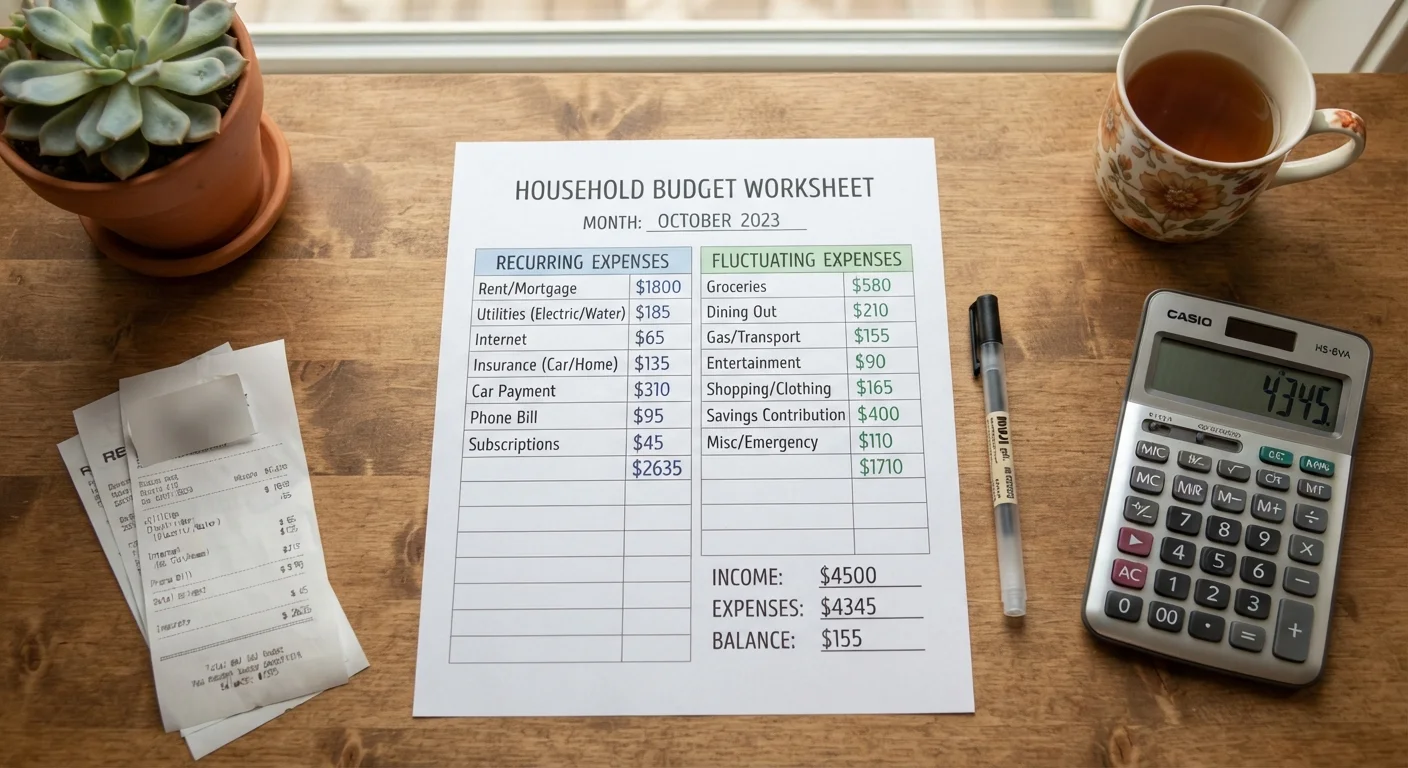
Photo credit: SkripTee.com | Search. Explore. Learn.
In this article
Fixed and variable expenses behave very differently in a budget. Here's what sets them apart and why it matters for your financial planning.
Key Takeaways
- Fixed expenses stay the same each month; variable expenses change based on behavior or circumstance.
- Both types must appear in your budget - ignoring either leads to shortfalls.
- Variable expenses offer more immediate opportunities to reduce spending when money is tight.
- Tracking variable spending for two to three months reveals realistic averages to budget against.
- Some expenses - like utilities - blend fixed and variable traits and need careful categorization.
What Makes an Expense Fixed or Variable?
Every dollar leaving your household falls into one of two behavioral categories: it either stays the same regardless of what you do, or it shifts based on your choices and circumstances.
Fixed expenses are costs that recur at a consistent amount on a predictable schedule. Your rent or mortgage payment, car loan installment, and most insurance premiums are classic examples. Whether you had a busy month or a quiet one, those bills arrive for the same amount. That consistency is precisely what makes them fixed.
Variable expenses, by contrast, fluctuate. Groceries, gasoline, utility bills, dining out, clothing, and entertainment can all cost more or less depending on your behavior, the season, or outside factors like fuel prices. You have to pay for food regardless, but how much you spend on food is partly within your control.
A useful way to test any expense: ask yourself, "If I checked this bill for the next six months, would the number be the same each time?" If yes, it is likely fixed. If the number moves, it is variable. For a plain-language reference covering this and other budgeting terms, see Key Budgeting Terms Every Household Should Know.
| Criterion | Fixed Expenses | Variable Expenses |
|---|---|---|
| Amount each month | Stays the same | Changes each month |
| Predictability | High - easy to plan for | Lower - requires estimation |
| Common examples | Rent, loan payments, insurance | Groceries, gas, dining, utilities |
| Ease of reducing | Difficult - contractually set | Easier - behavior-driven |
| Budget approach | List exact amounts | Average past spending |
| Response to income drop | Slow to adjust | Can be cut quickly |
Why the Distinction Matters in Practice
Treating all expenses the same is one of the most common budgeting mistakes. Fixed and variable costs require different planning strategies.
Because fixed expenses do not change, they are straightforward to plan for - list them, total them, and subtract from income. What remains is the income available for variable spending and savings goals. This is your "working budget."
Variable expenses demand a different approach: estimation. Since the amount changes, you need a reasonable monthly average. Financial planners generally recommend tracking variable categories for two to three months to establish a realistic baseline rather than guessing. Averaging past spending produces a far more accurate budget line than intuition alone.
~30%
Share of take-home pay often absorbed by fixed housing costs
The U.S. Department of Housing and Urban Development uses 30% of gross income as a general affordability threshold for housing expenses.
2-3 months
Tracking period recommended to average variable expenses
Consumer finance educators broadly recommend observing at least two to three months of actual spending to produce reliable variable-expense averages.
Fixed expenses also carry a different kind of risk. Because they are contractually set - leases, loan agreements, insurance contracts - reducing them usually requires negotiating, refinancing, or canceling a service. That takes time. Variable expenses, on the other hand, can be adjusted almost immediately, which is why they are the first place to look when income drops unexpectedly.
Once you understand how each type behaves, choosing a budgeting method becomes much clearer. See Budgeting Methods Explained for a breakdown of envelope, percentage, and pay-yourself-first approaches and how they handle both expense types.
The Grey Zone: Semi-Variable Expenses
Some expenses blur the line. Utilities are billed monthly like a fixed cost, but the amount changes with usage - making them semi-variable. A cell phone plan with a fixed base rate but variable data overage charges is another example. Subscription boxes, gym memberships with usage-based add-ons, and certain insurance plans with variable premiums also fall into this grey zone.
For budgeting purposes, the safest approach is to treat semi-variable expenses as variable: estimate based on your highest recent month, not your lowest. This creates a small buffer rather than a shortfall. If you consistently spend less than your estimate, that surplus rolls into savings - a better outcome than being caught short.
When 'Fixed' Doesn't Mean Forever
Fixed expenses can change - they just do so infrequently and usually with advance notice. Insurance premiums may rise at renewal, rent can increase when a lease turns over, and loan payments may change if you refinance. Review your fixed expense list at least once a year to make sure your budget reflects current amounts, not outdated ones.
Understanding these nuances also helps when you compare financial products. The same fixed-versus-variable logic applies to debt: a mortgage with a locked rate is a fixed expense, while a variable-rate loan can shift your monthly obligation. For more on that parallel, Fixed-Rate vs. Adjustable-Rate Mortgages walks through how rate structure affects your housing costs over time.
If you want a tool to organize both expense types, Spending Tracker vs. Budget Spreadsheet can help you decide which format suits the way you actually manage money.
This article is for general informational and educational purposes only and does not constitute personalized financial advice. Consult a qualified financial professional for guidance specific to your situation.

Author
Finance Editorial Team
Finance Editorial Team is the collective byline for our editorial team and contributor network. Articles published under this byline or an editorial pen name are researched, written, and reviewed according to our editorial standards for clarity, consistency, and independence before publication.
View all articles →