
A Field Guide to Fermented Drinks Around the World
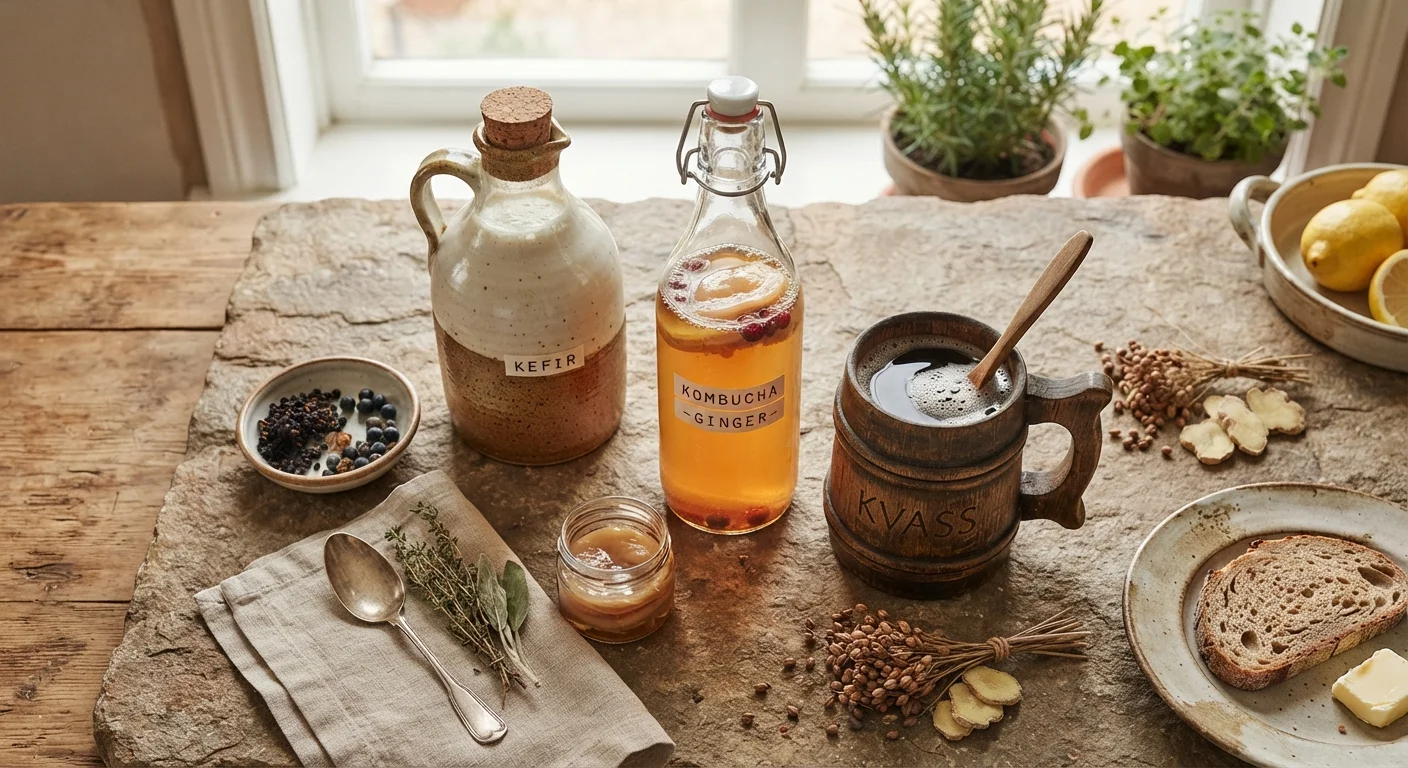
Photo credit: SkripTee.com | Search. Explore. Learn.
In this article
From kefir to kombucha to kvass, fermented beverages have deep cultural roots. Explore what they are and how they're made.
What Fermented Drinks Actually Are
Fermentation is one of humanity's oldest food technologies. At its core, it is a metabolic process in which microorganisms - bacteria, yeasts, or molds - convert sugars and starches into acids, gases, or alcohol. Applied to beverages, this process transforms simple liquids into complex, culturally significant drinks consumed across every continent.
Not all fermented drinks are alcoholic. Many rely primarily on lactic acid fermentation, which produces tangy, probiotic-rich beverages without significant alcohol content. Others use alcoholic fermentation, where yeasts convert sugars into ethanol. Some drinks, like kefir and kombucha, involve both processes simultaneously through a community of organisms.
| Oldest known fermented beverage | Likely fermented grain or honey drinks, with archaeological evidence dating back roughly 9,000 years (University of Pennsylvania Museum findings, Jiahu site, China) |
| Microorganisms involved | Bacteria, yeasts, or molds - often in combination |
| Alcohol content range | 0% ABV (mageu) to 3%+ ABV (kumiss, chicha) |
| US non-alcoholic threshold | Below 0.5% ABV (US TTB (Alcohol and Tobacco Tax and Trade Bureau)) |
| Common fermentation vessels | Ceramic crocks, wooden barrels, glass jars, food-grade plastic |
| Regions with longest fermented drink traditions | Central Asia, East Asia, Sub-Saharan Africa, Latin America, Eastern Europe |
Understanding this biological foundation helps consumers read labels more confidently, ask better questions at specialty grocers or restaurants, and appreciate why fermented drinks taste and behave so differently from one another.
A Region-by-Region Look at Notable Fermented Beverages
The diversity of fermented drinks mirrors the diversity of human agriculture. Each culture developed beverages using locally available ingredients and microbial communities that colonized their tools and environments over generations.
Fermentation
A metabolic process in which microorganisms convert sugars or starches into acids, alcohol, or gases. It is the foundation of all fermented foods and beverages.
SCOBY
Symbiotic Culture of Bacteria and Yeasts. A rubbery, pancake-like structure used to ferment kombucha; it contains the microbial community responsible for the drink's characteristic flavor and carbonation.
Lactic Acid Fermentation
A type of fermentation driven by lactic acid bacteria (LAB), which convert sugars into lactic acid. It produces tangy flavors and is common in kefir, kvass, and many vegetable-based ferments.
Koji
The mold Aspergillus oryzae, used across East Asian food traditions to break down starches in grains and legumes. It is central to producing amazake, sake, miso, and soy sauce.
Kefir Grains
Small, gelatinous clusters containing a stable community of bacteria and yeasts. They are added to milk or water to initiate fermentation and can be reused indefinitely with proper care.
ABV (Alcohol by Volume)
A standard measure of how much ethanol is present in a beverage, expressed as a percentage. Regulatory thresholds for "non-alcoholic" labeling vary by country; in the US, it is generally below 0.5% ABV.
Central Asia & Eastern Europe
- Kefir - Originating among the peoples of the Caucasus mountains, kefir is made by fermenting milk with kefir grains, a symbiotic culture of bacteria and yeasts. The result is a tart, slightly effervescent dairy drink. Non-dairy versions using water or plant-based milks are increasingly common.
- Kvass - A traditional Slavic beverage fermented from stale rye bread and water. Its flavor is mildly sour, lightly carbonated, and earthy. Alcohol content is typically very low (under 1.2% ABV), making it non-alcoholic by most regulatory definitions.
- Kumiss (Koumiss) - Traditionally made from fermented mare's milk across the Central Asian steppes. It contains moderate alcohol (1-3% ABV) and remains a culturally important drink in Kazakhstan and surrounding regions.
East Asia
- Amazake - A Japanese drink made from fermented rice using the mold Aspergillus oryzae (koji). It can be thick, sweet, and low-alcohol, or thin and served warm. It shares production lineage with sake and miso.
- Sikhye - A lightly fermented Korean rice beverage traditionally served sweet and chilled, often at the close of a meal. Fermentation is brief, yielding a mildly tangy, non-alcoholic profile.
Africa & Latin America
- Mageu (Mahewu) - A Southern African fermented maize drink, opaque and mildly sour, consumed widely as a nutritious everyday beverage. It is non-alcoholic.
- Chicha - An umbrella term for a variety of fermented beverages made across the Andes from maize, fruit, or other starches. Some versions are alcoholic, others are not, depending on fermentation duration and regional practice.
- Tepache - A Mexican fermented drink made from pineapple rinds and piloncillo (unrefined sugar). It is lightly fermented, mildly fizzy, and typically very low in alcohol.
Global Reach: Kombucha
Kombucha is produced by fermenting sweetened tea with a SCOBY (symbiotic culture of bacteria and yeasts). Though popularized in the West relatively recently, its origins trace to northeastern China around the early 20th century. Commercial kombucha sold in the United States must typically contain less than 0.5% ABV to be labeled non-alcoholic, though some varieties ferment beyond that threshold.
If you're curious about what goes into producing fermented grain beverages yourself, see our introduction to home brewing beer for a beginner-friendly breakdown. For context on how these compare to the growing no-and-low alcohol category, our explainer on non-alcoholic spirits and beer covers production methods in plain language.
Practical Considerations for Consumers
9,000+
Years humans have produced fermented beverages
Archaeological evidence from Jiahu, China, suggests fermented grain-and-fruit drinks were produced at least 9,000 years ago, according to research published in the Proceedings of the National Academy of Sciences.
0.5% ABV
US regulatory threshold for non-alcoholic labeling
The US Alcohol and Tobacco Tax and Trade Bureau (TTB) uses this threshold to define non-alcoholic beverages; many naturally fermented drinks fall near or around this line.
200+
Named fermented beverage varieties documented globally
Food anthropologists and fermentation researchers have catalogued hundreds of distinct regional fermented drinks, reflecting the breadth of microbial and agricultural traditions worldwide.
When purchasing or consuming fermented beverages, a few practical points are worth keeping in mind:
- Alcohol content varies widely. A drink labeled "fermented" can range from near-zero ABV (kvass, mageu) to wine-equivalent levels (some chicha). Always check the label.
- Live cultures aren't guaranteed. Pasteurization, used widely to extend shelf life, kills active microorganisms. If live bacterial cultures matter to you, look for labels that specify "raw," "unpasteurized," or "contains live cultures."
- Refrigeration matters. Many naturally fermented drinks continue fermenting if left warm. Store them as directed and consume by the best-by date.
Fermented Drinks and Health Claims
Some fermented beverages are marketed with probiotic or digestive health claims. While research into the gut microbiome is an active and promising area of science, the specific health benefits of individual fermented drinks vary significantly by product, processing method, and individual biology. This article is for general informational purposes and is not medical or dietary advice. Consult a qualified healthcare professional if you have specific health questions or conditions.
Fermented beverages are a genuinely broad category - from the sour tang of water kefir to the complex funkiness of a long-aged kvass. Approaching them with curiosity rather than expectation tends to be the most rewarding entry point.

Author
Food Editorial Team
Food Editorial Team is the collective byline for our editorial team and contributor network. Articles published under this byline or an editorial pen name are researched, written, and reviewed according to our editorial standards for clarity, consistency, and independence before publication.
View all articles →