
Green Tea, Black Tea, Oolong, and White Tea: One Plant, Many Faces
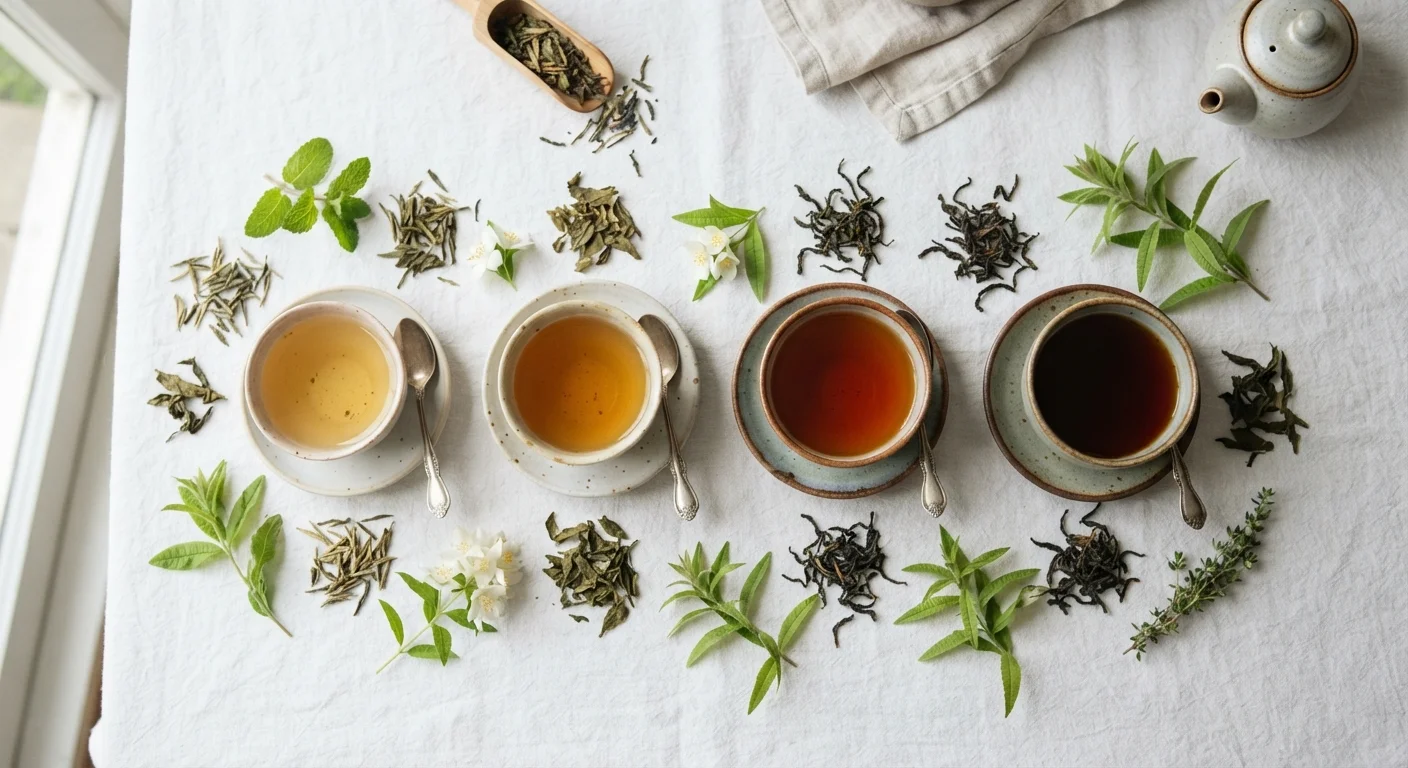
Photo credit: SkripTee.com | Search. Explore. Learn.
In this article
All true tea comes from Camellia sinensis. Discover how oxidation and processing turn one plant into four distinct drink categories.
Key Takeaways
- All four major tea types come from the same plant, Camellia sinensis.
- Oxidation level is the key factor that determines whether a tea is white, green, oolong, or black.
- White and green teas are minimally processed, preserving more delicate, grassy, or floral flavors.
- Black tea is fully oxidized, producing its characteristic bold, malty taste and darker color.
- Oolong sits between green and black, with flavor complexity that varies widely by producer.
- All true teas contain caffeine, though amounts differ by type, steep time, and leaf grade.
One Shrub, Countless Cups
Walk down any tea aisle and you'll encounter dozens of options spanning four broad categories: white, green, oolong, and black. It might surprise you to learn that all of them originate from a single botanical species - Camellia sinensis. What the farmer, processor, and artisan do with those leaves after picking determines everything: color, flavor, aroma, and even caffeine content.
This stands in interesting contrast to coffee, where variety and origin also matter greatly - but where processing similarly transforms the raw ingredient. Our explainer on how coffee processing shapes flavor draws a useful parallel for anyone curious about both beverages.
Understanding oxidation is the essential first step to reading a tea menu with confidence.
The Role of Oxidation
Oxidation is the enzymatic browning process that begins the moment a tea leaf is damaged - bruised, rolled, or cut. Oxygen interacts with compounds in the leaf called polyphenols, converting them into new molecules that affect color, taste, and antioxidant profile. Left unchecked, a green leaf will eventually turn fully brown; heat (firing, steaming, or pan-firing) stops this process in its tracks.
Tea producers use this reaction deliberately. By controlling when and how much oxidation occurs, they steer the final cup toward completely different flavor destinations.
~2,000
Recognized tea varieties worldwide
Estimates from tea research organizations suggest roughly 2,000 distinct tea varieties exist globally, all derived from Camellia sinensis and its sub-varieties.
15-85%
Oxidation range for oolong teas
The wide oxidation window used by oolong producers accounts for the category's dramatic flavor variation, from light and floral to dark and roasted.
6 billion
Cups of tea consumed daily worldwide
Tea is commonly cited as the second most consumed beverage in the world after water, with industry estimates suggesting around 6 billion cups consumed each day globally.
The spectrum runs from white tea (virtually no intentional oxidation) through green tea (oxidation halted very early), oolong (partial oxidation, highly variable), to black tea (fully oxidized). Each stop on this spectrum has its own sensory signature.
White, Green, Oolong, and Black: What Sets Each Apart
White Tea
White tea is the least processed of the four. Young buds and leaves are simply withered and dried - no rolling, no heat treatment designed to stop oxidation, though the process is slow and minimal by design. The result is a cup that tends toward pale gold with subtle floral, honeyed, or slightly grassy notes. Silver Needle and White Peony are two widely recognized styles.
Green Tea
Green tea leaves are heated quickly after harvest - steamed in Japan or pan-fired in China - to neutralize the oxidizing enzymes before they can act. This preserves the leaf's green color and produces the characteristic vegetal, grassy, or seaweed-like flavors associated with the category. Japanese matcha, a powdered green tea, fits within this family; our piece on matcha myths worth setting straight addresses the health claims that have grown up around it.
Oolong Tea
Oolong occupies a broad middle ground. Producers intentionally allow partial oxidation - anywhere from roughly 15% to 85% - before firing the leaf. A lightly oxidized oolong might taste floral and delicate, resembling green tea; a heavily oxidized one can approach the roasted depth of black tea. This variability is precisely what makes oolong one of the most complex and regionally expressive tea categories.
Black Tea
Black tea undergoes full oxidation before drying. The leaves turn dark brown or black, and the flavor becomes bolder, often malty, with lower levels of certain delicate polyphenols and a generally higher caffeine output per gram of dry leaf than other types. Assam, Darjeeling, and Ceylon are among the most recognized regional styles.
How Processing Affects What's in Your Cup
Beyond flavor, oxidation influences the chemistry of the leaf. Green and white teas retain higher concentrations of certain catechins - notably epigallocatechin gallate (EGCG) - because less oxidation means less transformation of these compounds. Black tea, by contrast, contains higher levels of theaflavins and thearubigins, which are created during oxidation and contribute to its characteristic color and astringency.
Brew Temperature Matters as Much as Tea Type
Delicate white and green teas can turn bitter when brewed with boiling water. Green teas generally benefit from water between 160°F and 180°F, while black teas tolerate a full boil. Using the right temperature is one of the simplest ways to improve your cup without changing anything else.
Research into the health effects of tea polyphenols is ongoing and genuinely promising in some areas, but most dietary authorities caution against drawing firm conclusions from studies that are often preliminary or conducted outside of typical human consumption contexts. Tea can be part of a varied, balanced diet - but it isn't a treatment for any condition.
Caffeine also varies. Brew time, water temperature, and leaf-to-water ratio all influence how much caffeine ends up in your cup - often more than the tea type itself. For a detailed breakdown, see our comparison of caffeine across popular beverages.
Frequently Asked Questions

Author
Food Editorial Team
Food Editorial Team is the collective byline for our editorial team and contributor network. Articles published under this byline or an editorial pen name are researched, written, and reviewed according to our editorial standards for clarity, consistency, and independence before publication.
View all articles →