
Casual Dining vs. Fine Dining: What Actually Changes Beyond the Price
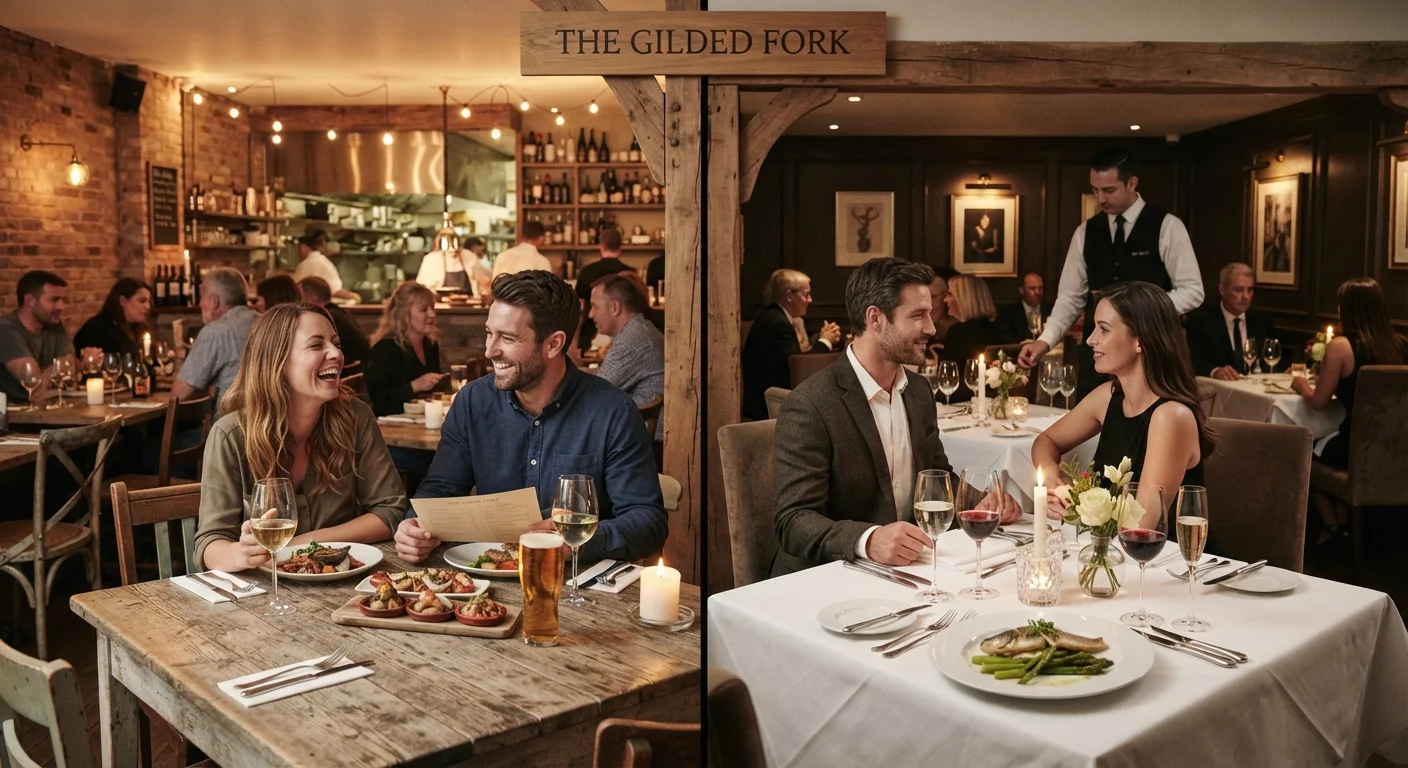
Photo credit: SkripTee.com | Search. Explore. Learn.
In this article
Service style, pacing, dress codes, and menu structure all shift between dining tiers. Here's what to realistically expect at each level.
Key Takeaways
- Service structure and pacing differ significantly between casual and fine dining, not just price.
- Fine dining typically involves more courses, stricter dress codes, and longer meal durations.
- Casual dining offers greater flexibility in ordering, timing, and attire with fewer unspoken expectations.
- Menu format - à la carte versus tasting or prix fixe - often signals which dining tier you're in.
- Knowing what to expect at each level leads to more satisfying, less stressful dining experiences.
How Service Style Actually Differs
The most immediate difference between casual and fine dining isn't what's on the plate - it's who's at your table and how often. In casual dining environments, servers typically manage larger sections, check in at key intervals, and prioritize efficiency. The interaction is friendly but transactional, aimed at turning tables at a reasonable pace.
Fine dining operates on a fundamentally different model. Service is structured around anticipation rather than reaction. Staff-to-diner ratios are higher, meaning water is refilled before you notice it's low, courses are cleared with choreographed timing, and a captain or sommelier may be involved alongside your primary server. This level of attentiveness isn't just cosmetic - it's the delivery mechanism for the entire experience.
Understanding service expectations ahead of time helps avoid frustration. In a fine dining setting, signaling for the check immediately after finishing your main course can feel rushed to staff. In casual dining, lingering too long after the meal may prompt gentle pressure. Neither is wrong - they simply reflect different operating rhythms. Before booking, our pre-dining checklist can help you align expectations with venue style.
| Criterion | Casual Dining | Fine Dining |
|---|---|---|
| Typical meal duration | 45-90 minutes | 2-3+ hours |
| Service model | Efficient, section-based | Anticipatory, team-based |
| Menu format | À la carte, flexible | Prix fixe or tasting menu |
| Dress code | None to smart-casual | Smart-casual to formal |
| Reservation requirement | Optional; walk-ins common | Usually required; often advance booking |
| Course structure | Diner-controlled | Kitchen-controlled sequence |
| Noise and atmosphere | Lively, informal | Subdued, curated ambiance |
Menu Structure, Pacing, and the Logic of Courses
Casual dining menus are almost universally à la carte: you order what you want, in whatever combination suits you, and the meal ends when you decide. This flexibility is part of the appeal. Starters are optional, dessert is an afterthought, and the full experience might span 45 to 75 minutes.
Fine dining restructures this entirely. Tasting menus - sequences of five to twelve or more smaller courses - are common, with each dish designed to build on the last in flavor, texture, and temperature. Prix fixe formats offer slightly more choice within a defined structure. Either way, the kitchen, not the diner, largely controls pacing. To understand how these formats work mechanically, see our guide to prix fixe, tasting menus, and other restaurant formats.
The logic behind multi-course sequencing isn't arbitrary. A well-structured restaurant meal progresses through distinct stages - amuse-bouche, appetizer, intermezzo, main, pre-dessert, dessert - each calibrated to reset the palate and sustain engagement over two to three hours. At the casual tier, this architecture is compressed or absent entirely.
2-3 hrs
Typical fine dining meal duration
Industry guidelines from culinary institutions consistently cite multi-course fine dining meals as spanning two to three hours, compared to under 90 minutes for casual formats.
5-12+
Courses in a typical tasting menu
Most fine dining tasting menus in the US range from five to twelve courses, with some chef's table experiences extending further depending on the kitchen's philosophy.
Dress Codes, Reservations, and Unspoken Expectations
Dress codes are perhaps the most anxiety-inducing element for diners crossing into fine dining for the first time. Most casual restaurants have no stated code; smart-casual attire is broadly acceptable and enforcement is essentially nonexistent. Fine dining venues range from business casual to formally required jacket-and-tie policies. When in doubt, check the restaurant's website directly - most fine dining establishments state their expectations explicitly.
Reservations follow a similar pattern. Walk-ins are routine at casual spots, and digital waitlists have made managing the queue more transparent. At fine dining establishments, reservations - sometimes made weeks or months in advance - are standard, and cancellation policies with deposits are increasingly common. Our overview of reservation platforms, walk-ins, and waitlists explains the mechanics of booking across dining tiers.
Other unspoken expectations at the fine dining level include silencing phones, speaking at conversational volume, and following the server's lead on course timing rather than rushing. These aren't arbitrary rules - they protect the experience for everyone in the room.
Neither Tier Is Objectively Superior
Casual and fine dining serve genuinely different purposes, and the right choice depends entirely on context. A well-executed casual meal can be deeply satisfying; a poorly matched fine dining occasion can feel alienating or wasteful. The goal is alignment between your expectations, the occasion, and the environment - not a ranking of one tier over the other.

Author
Food Editorial Team
Food Editorial Team is the collective byline for our editorial team and contributor network. Articles published under this byline or an editorial pen name are researched, written, and reviewed according to our editorial standards for clarity, consistency, and independence before publication.
View all articles →