
Whole Grains vs. Refined Grains: What Changes When Wheat Gets Processed
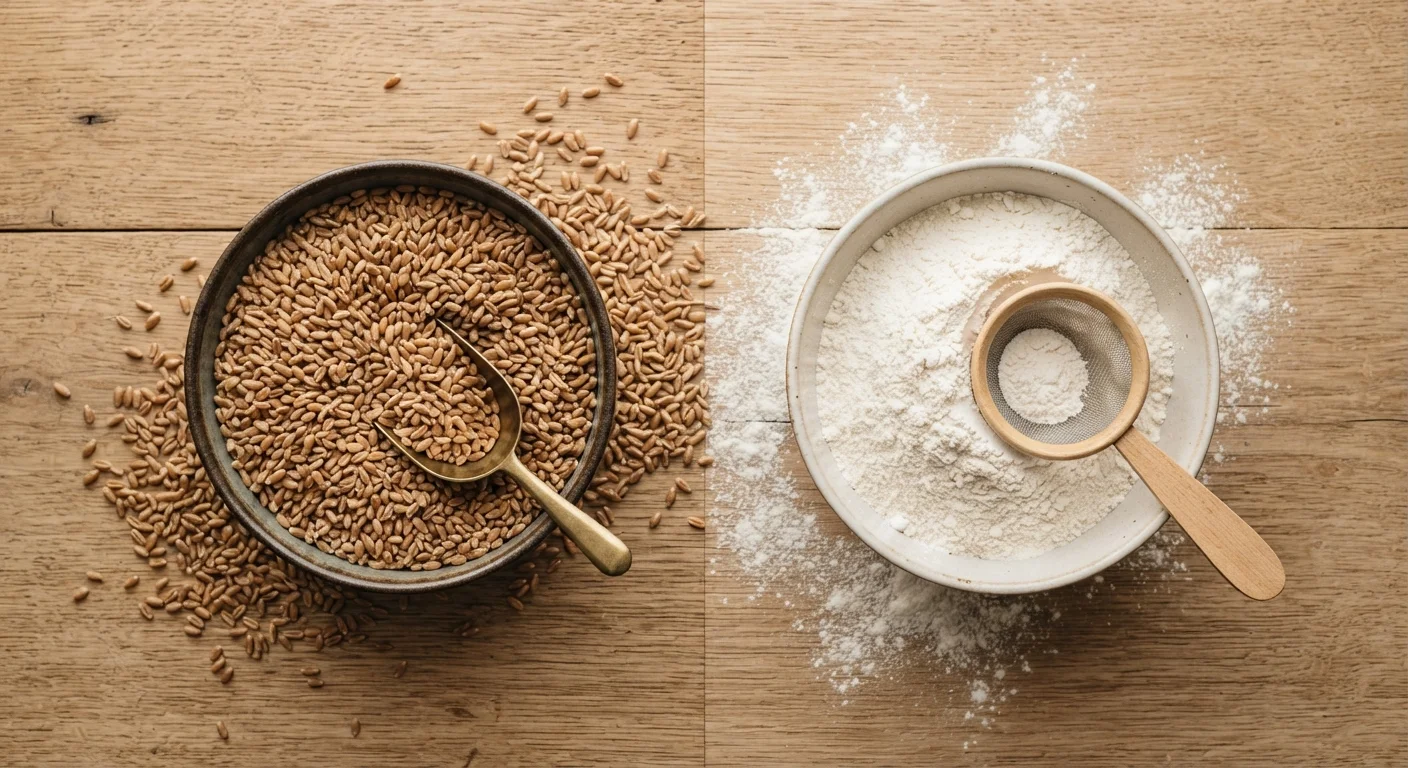
Photo credit: SkripTee.com | Search. Explore. Learn.
In this article
See what's lost when grains are refined, how whole grains differ nutritionally, and what that means for everyday food choices.
Key Takeaways
- Milling removes the bran and germ from wheat, stripping fiber, B vitamins, iron, and healthy fats.
- Whole grains retain all three kernel layers - bran, germ, and endosperm - and their associated nutrients.
- Enrichment adds back select B vitamins and iron, but does not restore fiber or all original micronutrients.
- Dietary guidelines from the USDA recommend making at least half of daily grains whole grains.
- Ingredient lists and the '100% whole grain' label claim are more reliable than color or texture alone.
What Happens Inside the Mill
A grain of wheat has three distinct parts: the outer bran, the nutrient-rich inner germ, and the starchy core called the endosperm. When wheat is milled into white flour, industrial rollers strip away the bran and germ, leaving behind almost exclusively the endosperm. That endosperm is largely starch and some protein - the structural backbone of bread and pasta - but it holds only a fraction of the original kernel's nutritional complexity.
What's lost in that separation is substantial. The bran contributes the majority of a grain's dietary fiber, along with B vitamins like niacin and thiamine. The germ supplies vitamin E, folate, healthy unsaturated fats, and additional B vitamins. Once those layers are removed, refined flour has a dramatically different nutrient profile than the original grain - even though it comes from the same raw ingredient.
| Criterion | Whole Grains | Refined Grains |
|---|---|---|
| Kernel layers retained | Bran, germ, and endosperm | Endosperm only |
| Dietary fiber | High (e.g., ~3g per slice whole wheat bread) | Low (e.g., ~1g per slice white bread) |
| B vitamins | Naturally present | Partially restored via enrichment |
| Vitamin E | Present (from germ) | Largely absent |
| Glycemic response | Generally lower | Generally higher |
| Shelf life | Shorter (germ fats can oxidize) | Longer (germ removed) |
| Texture in baking | Denser, heartier | Lighter, more tender |
Enrichment: What It Restores - and What It Doesn't
Since the mid-20th century, refined grain products in the U.S. have been required to be enriched, meaning specific nutrients are added back after milling. Under standards set by the FDA, enriched flour must contain added thiamine, riboflavin, niacin, folic acid, and iron. Enrichment meaningfully addresses some nutrient gaps - the mandatory addition of folic acid to enriched grains has been credited with contributing to reduced rates of neural tube defects in the U.S.
However, enrichment does not restore everything. Dietary fiber - one of the most consequential nutrients lost in milling - is not added back. Neither is vitamin E, magnesium, zinc, or the full spectrum of phytochemicals and antioxidants present in the bran and germ. The result is a product that meets a narrow set of nutritional benchmarks while remaining significantly lower in fiber and overall micronutrient complexity than its whole grain counterpart.
A Note on 'Whole Grain' Label Claims
The phrase "made with whole grains" has no federally mandated minimum content threshold in the U.S., meaning a product could qualify with a very small percentage of whole grain flour. Look for "100% whole grain" or check that a whole grain is listed as the first ingredient. The Whole Grains Council's stamp is a voluntary industry label that specifies grams of whole grain per serving, which can also be a useful reference point.
For a practical look at how to spot whole grain claims on packaging, see our guide on reading a nutrition label.
Reading Labels: Finding Whole Grains at the Store
Color and marketing terms can be misleading. Bread labeled "wheat bread" or "multigrain" may still be made primarily with refined flour. The most reliable indicator is the ingredient list: if a whole grain - such as "whole wheat flour," "whole oats," or "whole grain corn" - appears as the first ingredient, the product is predominantly whole grain. The claim "100% whole grain" is more stringent and generally more trustworthy than "made with whole grains," which has no minimum threshold requirement.
The USDA's Dietary Guidelines for Americans recommend that at least half of all grains consumed daily be whole grains. That's a population-level framework, not an all-or-nothing rule. Understanding what processing removes - rather than treating refined grains as categorically off-limits - gives consumers a more nuanced and sustainable basis for daily choices. This grain-processing question also connects to the broader conversation about how whole foods compare to ultra-processed products in the overall diet.
~25%
Fiber retained after standard wheat milling
Milling to produce white flour removes roughly 75% of the dietary fiber present in the original whole wheat kernel, according to grain science literature.
50%
Daily grains that should be whole grains
The USDA Dietary Guidelines for Americans recommend that at least half of all grains consumed each day come from whole grain sources.
~20
Nutrients reduced or lost in refinement
Research published in nutritional epidemiology literature identifies approximately 20 or more vitamins, minerals, and phytonutrients that are significantly diminished when whole grains are refined.

Author
Food Editorial Team
Food Editorial Team is the collective byline for our editorial team and contributor network. Articles published under this byline or an editorial pen name are researched, written, and reviewed according to our editorial standards for clarity, consistency, and independence before publication.
View all articles →