
A Plain-Language Guide to Common Fitness Terms
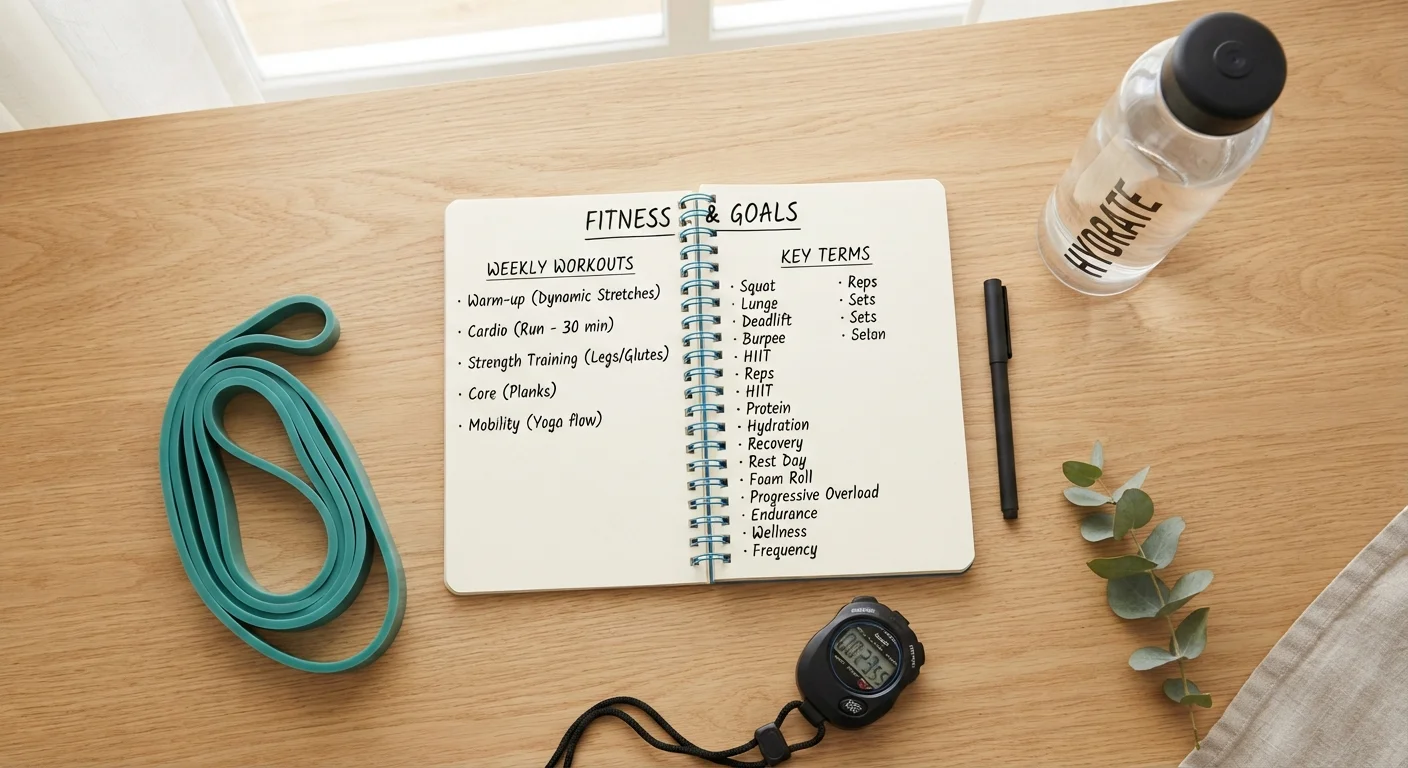
Photo credit: SkripTee.com | Search. Explore. Learn.
In this article
Sets, reps, progressive overload, HIIT — fitness has its own vocabulary. This reference explains key terms clearly for anyone new to the space.
Why Fitness Terminology Can Feel Like a Second Language
Walk into any gym or open a fitness app for the first time and you're likely to encounter a wall of unfamiliar words: reps, AMRAP, periodization, VO2 max. This specialized vocabulary can make fitness feel exclusive - but the concepts underneath are usually straightforward once they're explained clearly.
This reference covers the terms you'll encounter most often as a beginner or casual exerciser. It's organized so you can read straight through or jump to the term you need. For a similar reference covering eating and nutrition vocabulary, see Key Nutrition Terms Defined.
Rep (Repetition)
One complete performance of an exercise movement from start to finish. For example, lowering into a squat and returning to standing counts as one rep.
Set
A group of consecutive reps performed without stopping. A workout might prescribe multiple sets of the same exercise with rest periods in between.
Progressive Overload
The principle of gradually increasing the demands placed on the body - through more weight, reps, or reduced rest - to continue stimulating adaptation and improvement over time.
HIIT
High-Intensity Interval Training. A format alternating short, intense exercise bursts with recovery periods. Associated with cardiovascular and metabolic benefits, though it places higher demands on the body than moderate-intensity exercise.
AMRAP
"As Many Reps (or Rounds) As Possible." A timed workout format where the goal is to complete as many repetitions or full exercise circuits as you can within a given time.
VO2 Max
The maximum volume of oxygen your body can use per minute during intense exercise. A commonly used indicator of aerobic fitness capacity.
Rest Interval
The time spent recovering between sets or exercises. Rest length influences the training effect, with shorter rests increasing cardiovascular challenge and longer rests supporting heavier lifting.
Volume (Training Volume)
The total amount of work performed in a training session or over a week. Often calculated by multiplying sets, reps, and weight lifted. Tracking volume helps measure whether training load is changing over time.
Core Workout Structure Terms
Most workout plans are built around a handful of structural concepts. Once you understand these, reading any exercise prescription becomes much easier.
| What a "Rep" Means | One complete exercise movement (e.g., one squat) |
| What a "Set" Means | A group of consecutive reps without rest |
| HIIT Definition | High-Intensity Interval Training - intense bursts + recovery periods |
| Progressive Overload | Gradually increasing training demand over time to drive adaptation (Widely established principle in exercise science) |
| AMRAP | As Many Reps (or Rounds) As Possible in a set time |
| VO2 Max | Maximum oxygen use during intense exercise; marker of aerobic fitness |
Sets and reps are the fundamental unit of resistance training. A rep (repetition) is one complete movement - one squat up and down, one push-up. A set is a group of consecutive reps performed without stopping. So "3 sets of 10 reps" means you do the exercise 10 times, rest, and repeat that sequence twice more.
Rest intervals refer to the time you pause between sets. Shorter rest periods (30-60 seconds) tend to increase cardiovascular challenge; longer rest periods (2-3 minutes) allow more muscle recovery between heavy efforts. Neither is universally better - it depends on your goal.
Progressive overload is the gradual increase in training demand over time - adding weight, increasing reps, or reducing rest - so the body continues adapting. It's one of the most well-supported principles in exercise science. Without it, progress tends to plateau. This principle applies whether you train at home or in a gym; see Home Workouts vs. Gym Training for how environments affect your options.
Volume describes the total workload in a session or week, often calculated as sets × reps × weight. Tracking volume helps gauge whether training load is increasing, stable, or declining.
Cardio and Conditioning Vocabulary
Cardiovascular training has its own set of terms, many tied to exercise intensity.
HIIT stands for High-Intensity Interval Training - alternating short bursts of intense effort with recovery periods. Research generally supports HIIT as an efficient way to improve cardiovascular fitness, though it's more demanding on the body than steady-state cardio and isn't appropriate for every fitness level.
Steady-state cardio means exercising at a consistent, moderate intensity for a sustained period - a 30-minute jog at a comfortable pace, for example. It's a reliable, lower-impact way to build aerobic endurance.
AMRAP stands for "As Many Reps (or Rounds) As Possible" within a set time. It's a common format in circuit and functional training workouts. For a deeper look at functional training concepts, What 'Functional Fitness' Actually Means is a useful companion read.
VO2 max is the maximum rate at which your body can use oxygen during intense exercise. It's considered a reliable marker of aerobic fitness. While lab testing is the gold standard, many fitness trackers now offer estimates - though those estimates vary in accuracy.
Fitness Terms Don't Have Universal Definitions
Some fitness terms - like "functional training" or "toning" - are used inconsistently across gyms, trainers, and apps. When a plan or instructor uses a term you're unsure about, it's always appropriate to ask for clarification. Don't let unfamiliar language become a barrier to getting started. You may also find it helpful to check Fitness Myths That Keep People From Getting Started to separate widely repeated misconceptions from what the evidence actually supports.
This article is for informational purposes only and is not a substitute for personalized advice from a qualified fitness or healthcare professional. If you have an existing health condition or are new to exercise, consult a professional before beginning a new program.

Author
Health Editorial Team
Health Editorial Team is the collective byline for our editorial team and contributor network. Articles published under this byline or an editorial pen name are researched, written, and reviewed according to our editorial standards for clarity, consistency, and independence before publication.
View all articles →