
Decoding Pet Food Labels: What Ingredients Lists and Guaranteed Analysis Really Mean
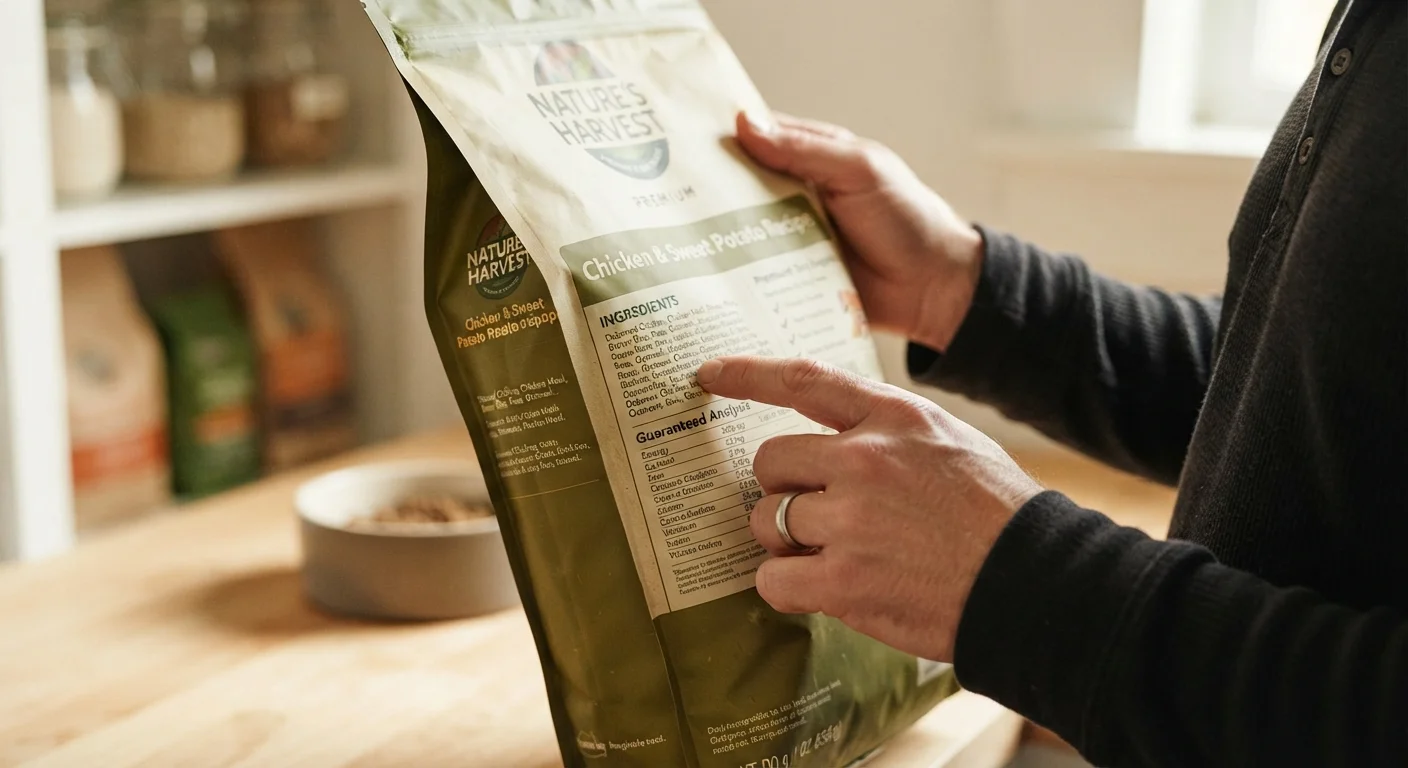
Photo credit: SkripTee.com | Search. Explore. Learn.
In this article
Pet food packaging can be confusing. Learn how to read ingredient lists, guaranteed analysis panels, and nutritional claims with confidence.
Key Takeaways
- Ingredients are listed by pre-cooking weight, so meat listed first doesn't always mean it's the dominant nutrient source.
- The guaranteed analysis shows nutrient minimums and maximums, not exact amounts.
- AAFCO nutritional adequacy statements tell you whether a food is complete and balanced for your pet's life stage.
- Marketing terms like 'natural' and 'holistic' have limited or no regulatory definitions in pet food.
- Comparing wet and dry foods requires a dry-matter basis conversion for accuracy.
- When in doubt about your pet's specific nutritional needs, consult your veterinarian.
How Ingredient Lists Actually Work
Pet food ingredient lists follow one firm rule: ingredients are listed in descending order by pre-cooking weight. That sounds straightforward, but moisture content complicates things. Fresh chicken, for example, is roughly 70% water. After processing, the actual protein contribution may be smaller than it appears, while a meal-form ingredient listed lower - like "chicken meal" - has already had moisture removed and can deliver more concentrated protein per gram.
This is why reading just the first ingredient can be misleading. A useful habit is to scan the first five to eight ingredients as a group. That cluster generally reflects the bulk of the diet's composition. Ingredients appearing after salt or after a vitamin-mineral premix are typically present in very small amounts.
Ingredient splitting is another practice to recognize. A manufacturer might list "ground corn," "corn gluten meal," and "corn bran" separately, each placing lower on the list than a single combined "corn" entry would. This isn't illegal, but it can shift the visual emphasis toward a protein source that may not dominate the diet by weight.
Scan Ingredients as a Group, Not One by One
Rather than fixating on the single first ingredient, read the first five to eight ingredients as a cluster. This gives you a much more realistic sense of what the diet is primarily made of. Ingredients listed after salt or after a vitamin-mineral blend are present in negligible amounts.
Reading the Guaranteed Analysis Panel
Every commercially sold pet food in the U.S. must include a guaranteed analysis, regulated by AAFCO and enforced at the state level. It lists, at minimum:
- Crude protein (minimum %)
- Crude fat (minimum %)
- Crude fiber (maximum %)
- Moisture (maximum %)
The word "crude" here refers to the laboratory method used - it doesn't imply anything about quality. These are guaranteed ranges, not exact figures. The actual protein in a bag might be higher than the stated minimum.
The most important practical point: you cannot directly compare a wet food's guaranteed analysis to a dry food's. A wet food might show 10% protein while a dry food shows 30%, but the wet food's protein is diluted by its 78% moisture content. To make a fair comparison, use the dry-matter basis (DMB) formula: divide the nutrient % by (100 − moisture %) × 100. On a dry-matter basis, that 10% wet food protein often rivals or exceeds a dry food's equivalent.
~70%
Moisture content in fresh meat ingredients
Fresh or refrigerated meat listed first on an ingredient panel is roughly 70% water, which affects its actual contribution after cooking and processing.
4
Required nutrients on every guaranteed analysis panel
AAFCO requires all U.S. pet food labels to guarantee at minimum crude protein, crude fat, crude fiber, and moisture percentages.
2
AAFCO methods for nutritional adequacy claims
A food can earn an AAFCO adequacy statement either through laboratory formulation to meet nutrient profiles or by completing a live animal feeding trial.
Decoding Nutritional Adequacy Statements
Below the guaranteed analysis - sometimes in small print - you'll find an AAFCO nutritional adequacy statement. This is arguably the most important line on the entire package. It tells you whether the food is intended as a complete diet and for which life stage.
Look for language like: " is formulated to meet the nutritional levels established by the AAFCO Dog Food Nutrient Profiles for maintenance." Life stage categories include growth (puppies/kittens), maintenance (adult), all life stages, and reproduction. A food labeled "all life stages" meets the higher nutritional bar set for growth and reproduction.
If a label says "for supplemental or intermittent feeding only," that food is not nutritionally complete on its own and shouldn't be a pet's sole diet. Treats often carry this designation. For a balanced look at how diet format affects these considerations, see our article on raw diets vs. commercial pet food.
What Marketing Terms Do - and Don't - Mean
Pet food packaging is marketing territory, and some terms carry regulatory weight while others are largely unregulated. Here's a quick breakdown:
- "Natural"
- AAFCO has a definition: ingredients not produced by synthesis. However, it doesn't speak to sourcing quality, farming practices, or nutritional superiority.
- "Holistic"
- No regulatory definition exists in pet food. It's a marketing descriptor with no enforceable standard.
- "Grain-free"
- Describes what's absent, not what's present. Grain-free doesn't automatically mean low-carbohydrate; starches like peas and potatoes are common substitutes. Ongoing research has examined potential associations between grain-free diets and certain heart conditions in dogs - discuss this with your vet.
- "Human-grade"
- Has a specific AAFCO definition requiring the entire product to be fit for human consumption and manufactured in a human-food facility. "Human-grade ingredients" without that full claim is a weaker, less regulated phrase.
Understanding these distinctions helps you evaluate packaging claims more objectively. For a parallel look at how labeling language works on human food products, the guide to reading a nutrition label offers a useful comparison point.
“Pet food labels contain more regulated information than many owners realize - but that information requires some decoding. The guaranteed analysis and the AAFCO statement are your most reliable starting points, not the front-of-bag marketing.”
— Lisa Freeman, Board-certified veterinary nutritionist and professor of clinical nutrition, widely published on pet food labeling and diet evaluation
As always, if your pet has a specific health condition, age-related need, or dietary sensitivity, work directly with your veterinarian or a board-certified veterinary nutritionist rather than relying solely on label claims. For broader context on evidence-based nutrition, see our overview of pet ownership basics.
This article is for general informational purposes only and is not a substitute for professional veterinary advice. Consult your veterinarian for guidance tailored to your individual pet's health needs.
Frequently Asked Questions

Author
Pets Editorial Team
Pets Editorial Team is the collective byline for our editorial team and contributor network. Articles published under this byline or an editorial pen name are researched, written, and reviewed according to our editorial standards for clarity, consistency, and independence before publication.
View all articles →