
Traveling with Medications: What Borders, Climates, and Timing Mean for Your Health
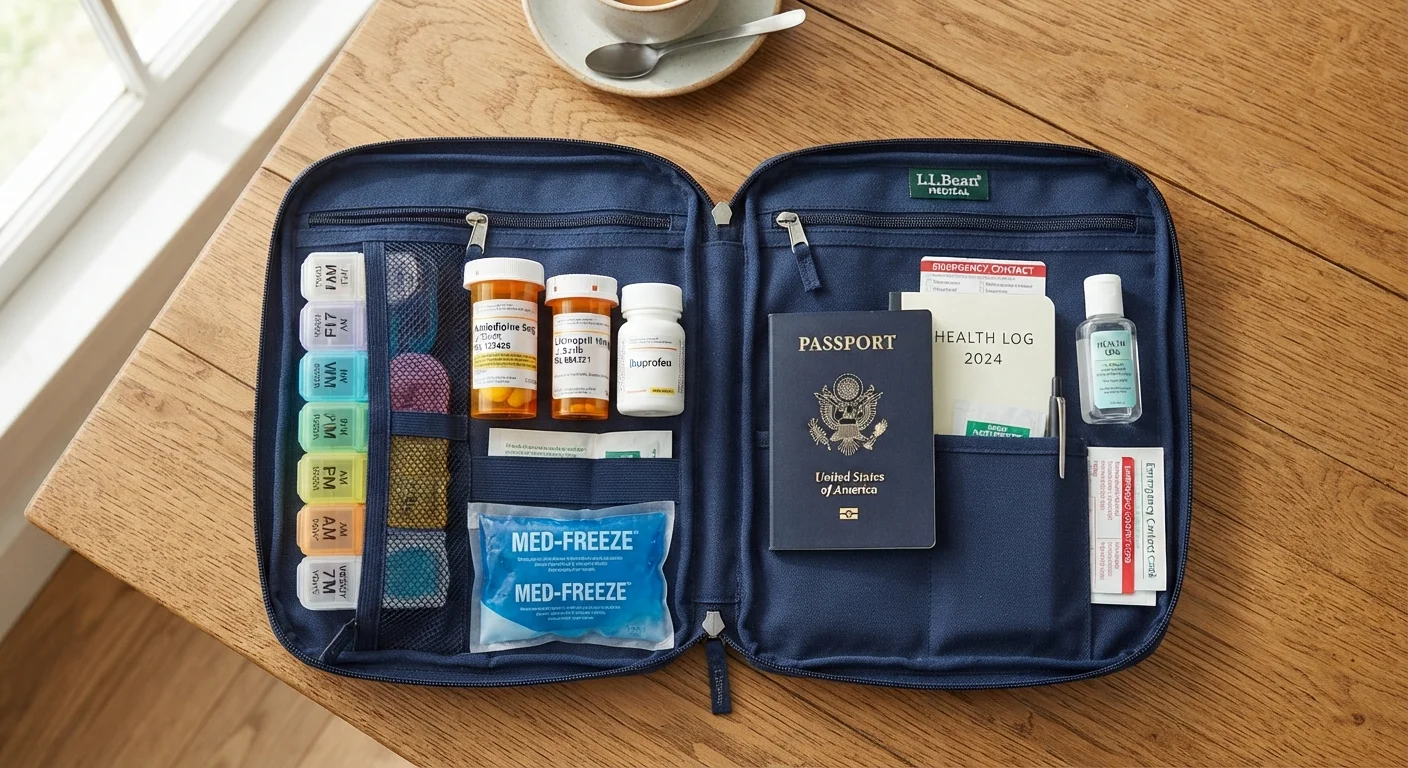
Photo credit: SkripTee.com | Search. Explore. Learn.
In this article
General guidance on carrying medications across borders, managing storage conditions, and knowing when to consult a healthcare provider before departure.
Border Rules and Controlled Substances
Crossing an international border with prescription medications is generally straightforward - until it isn't. Most countries permit travelers to carry a personal supply of common medications, but the definition of "common" varies widely. Controlled substances that are legal in the United States, including certain opioid pain relievers, stimulants, and benzodiazepines, may be classified differently - or outright banned - in your destination country.
Before departure, verify the specific rules of every country on your itinerary. This is especially relevant when traveling through multiple countries, where each border crossing introduces its own requirements. Official government sources and your destination country's embassy website are the most reliable starting points. Never assume that a valid U.S. prescription grants automatic entry permission elsewhere.
Practical steps worth taking:
- Carry medications in their original, labeled pharmacy containers whenever possible.
- Bring a signed letter from your prescribing physician that includes your diagnosis, the medication name (both brand and generic), dosage, and the medical necessity.
- For controlled substances, research whether an import permit or official declaration form is required at customs.
- Carry enough supply for the trip plus a buffer - but be aware that some countries cap the permitted quantity, often at a 30- to 90-day supply.
Climate, Storage, and Medication Stability
Temperature and humidity can degrade medications faster than expiration dates suggest. Insulin, certain biologics, and some liquid antibiotics require refrigeration and lose potency if exposed to heat for prolonged periods. Even medications stored at room temperature can be affected by the extreme heat found in parked vehicles, beachside bags, or humid tropical environments.
Cold chain
An uninterrupted temperature-controlled supply and storage process for medications that require refrigeration. Breaking the cold chain - even briefly - can render some drugs ineffective or unsafe.
Controlled substance
A drug regulated by law because of its potential for misuse or dependence. Classification varies by country; a substance legal in the U.S. may be restricted or prohibited elsewhere.
Generic name
The non-brand, chemical name of a medication recognized internationally. Using a drug's generic name in documentation helps customs officials and foreign pharmacies identify it accurately.
Half-life
The time it takes for the concentration of a drug in the body to reduce by half. Medications with a short half-life are more sensitive to missed or mistimed doses, which is important to understand when crossing time zones.
Practical storage strategies include:
- Insulated cases: Soft-sided insulated pouches with reusable ice packs can maintain a safe temperature range for several hours. Research the specific temperature window required for your medication before choosing a solution.
- Hotel refrigerators: Most hotels will accommodate refrigeration requests. Confirm availability before booking, particularly for cruise cabins, where mini-fridges may default to cooler (not refrigerator-cold) settings.
- Carry-on placement: Always pack medications in your carry-on luggage, not checked baggage, which is subject to unpredictable temperature extremes in cargo holds.
For those taking a cruise, consult the ship's medical center in advance - most vessels can store medications requiring strict refrigeration, but coordination before boarding is essential.
This article provides general travel information only and is not a substitute for advice from a licensed healthcare professional. Consult your doctor or pharmacist before making changes to how you store or transport any medication.
Time Zones, Schedules, and Pre-Departure Planning
Time-sensitive medications - including thyroid hormones, HIV antiretrovirals, and certain psychiatric drugs - require consistent dosing intervals. Crossing multiple time zones can disrupt that rhythm in ways that have real clinical consequences. There is no universal rule for adjusting schedules across time zones; the right approach depends on the medication's mechanism, half-life, and your individual health status. Your prescribing physician should guide any adjustment plan.
No Universal Rule for Time-Zone Dosing
Guidance on shifting medication schedules across time zones is highly individual and depends on the specific drug, your health condition, and direction of travel (eastward versus westward). Some medications tolerate flexibility; others do not. Always consult your prescribing physician or pharmacist well before departure - ideally four to six weeks out - so any adjustment plan can be tested and refined before you leave home.
General considerations worth discussing with your provider before departure:
- Whether to shift dose timing gradually in the days before travel or adjust on arrival.
- How to handle the dose taken during a very long travel day that spans multiple time zones.
- Whether a short-term supply of a slightly different formulation (extended-release versus immediate-release) would ease the transition.
Beyond scheduling, a pre-departure medical consultation is advisable for any traveler managing a chronic condition, traveling to a remote destination, or undertaking a trip lasting more than a few weeks. See our pre-departure checklist for a broader view of what to arrange before you leave, and consider pairing it with our packing checklist to ensure your health essentials are accounted for alongside everything else. For a comprehensive look at international health preparation, the international travel planning resource covers vaccinations, documentation, and destination-specific health considerations in detail.

Author
Travel Editorial Team
Travel Editorial Team is the collective byline for our editorial team and contributor network. Articles published under this byline or an editorial pen name are researched, written, and reviewed according to our editorial standards for clarity, consistency, and independence before publication.
View all articles →