
Phrases, Units, and Customs: The Reference Sheet for Travelling in an Unfamiliar Country
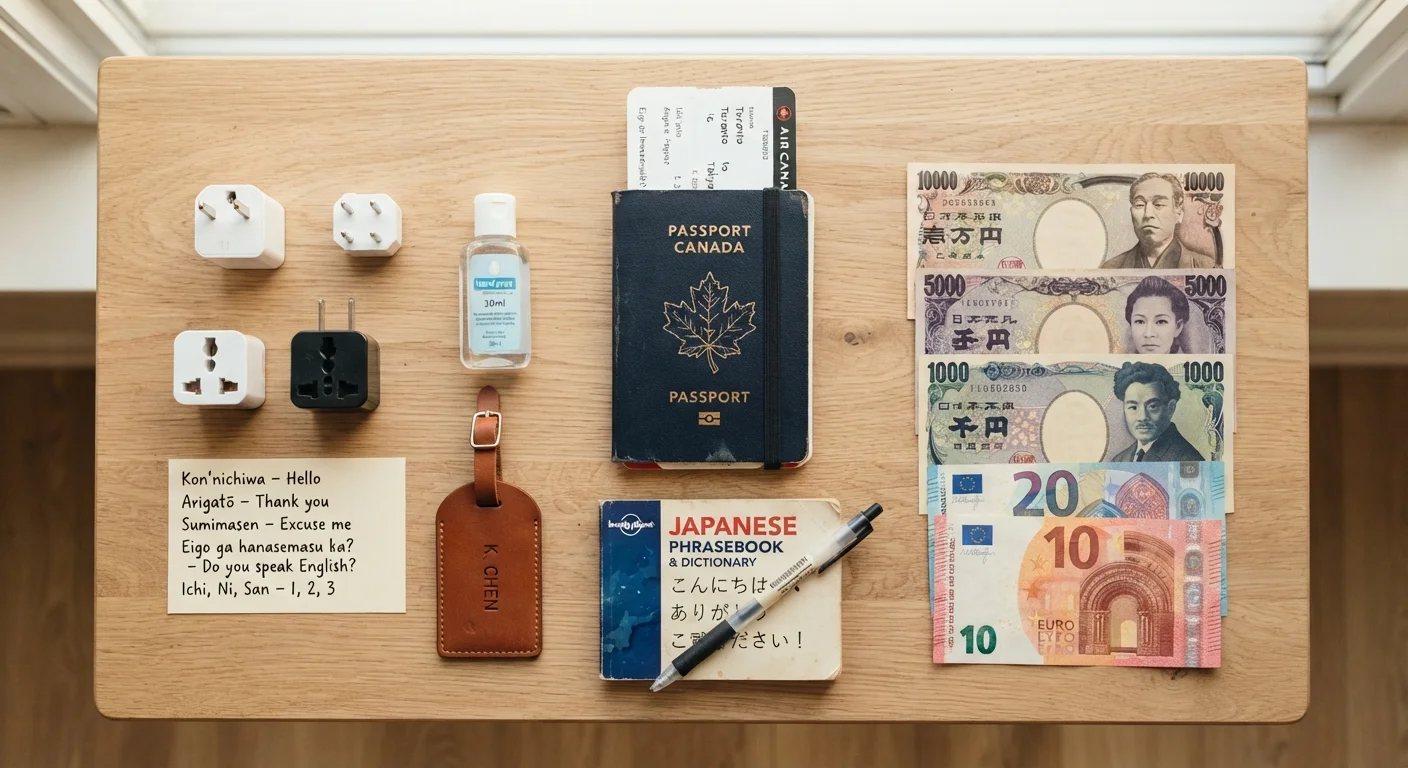
Photo credit: SkripTee.com | Search. Explore. Learn.
In this article
A quick-reference guide to currency conversions, local tipping norms, plug types, and cultural customs to understand before arriving somewhere new.
Currency, Conversion, and Paying Without Confusion
Before you arrive anywhere new, understand the local currency - its name, denominations, and approximate exchange rate against the US dollar. Exchange rates fluctuate, so treat any pre-trip figure as an estimate rather than a guarantee. Use it to build mental benchmarks: if a meal costs 150 units of a currency you've never handled, you want to know instantly whether that's $3 or $30.
A few principles hold almost universally. First, dynamic currency conversion (DCC) - where a foreign ATM or card terminal offers to charge you in US dollars instead of local currency - typically benefits the vendor, not you. Declining DCC and paying in local currency usually yields a better rate. Second, many countries outside Western Europe are still heavily cash-dependent; arriving with no local currency because you expected card acceptance everywhere is a common and avoidable mistake. Third, always carry small-denomination bills for markets, taxis, and street food stalls where vendors rarely make change for large notes.
For a broader pre-departure financial checklist, the complete international travel planning resource covers currency strategy alongside documentation and health prep.
Tipping Norms Around the World
Tipping is one of the most culturally variable practices a traveler encounters. In the United States, tipping service workers is standard and often expected. In Japan, tipping is generally considered rude and can cause genuine discomfort. In many parts of Europe, rounding up the bill or leaving small change is appreciated but not obligatory. In parts of Southeast Asia and the Middle East, tipping in tourist-facing restaurants has become more common but is still discretionary.
As a quick orientation framework:
- No tipping expected or welcome: Japan, South Korea, some Scandinavian countries
- Small tips appreciated: Most of continental Europe, Australia, New Zealand
- Tipping common in tourist contexts: Thailand, Egypt, Mexico, Morocco
- Tipping strongly expected: United States, Canada, some Caribbean destinations
When in doubt, observe what locals do. For a deeper breakdown of how gratuity logic works, see the unwritten rules of tipping.
Units of Measurement and Temperature at a Glance
Most of the world uses the metric system. As a US traveler, the most frequent friction points are temperature, distance, and volume. A few anchor conversions are worth memorising before departure:
Dynamic Currency Conversion
A service offered by some foreign ATMs and card terminals that charges you in your home currency rather than local currency. It usually applies a less favorable exchange rate and benefits the merchant.
Dual-voltage device
An electronic device designed to operate on both 110-120V and 220-240V electrical standards. Check the device label for the input range - if it shows both voltages, a plug adapter is sufficient without a transformer.
Type G plug
An electrical plug standard featuring three rectangular prongs in a triangular pattern, used in the UK, Ireland, Singapore, Hong Kong, and several other countries.
Wai
A traditional Thai greeting made by pressing the palms together at chest level and bowing slightly. It is used to show respect and is the culturally appropriate alternative to a handshake in many formal situations.
Metric system
The international system of measurement using kilometers, kilograms, Celsius, and liters. It is the standard in virtually every country except the United States.
Entry visa
Official authorization, typically stamped in a passport or issued electronically, allowing a traveler to enter a specific country for a defined purpose and duration. Requirements vary by nationality and destination.
- Temperature: 0°C = 32°F (freezing), 20°C ≈ 68°F (mild), 30°C ≈ 86°F (hot), 37°C = body temperature
- Distance: 1 kilometer ≈ 0.62 miles; 100 km ≈ 62 miles (useful for interpreting road signs)
- Weight: 1 kilogram ≈ 2.2 pounds; 100 grams ≈ 3.5 ounces
- Volume: 1 liter ≈ 0.26 US gallons (relevant at gas stations)
Speed limits posted in km/h are also critical if you plan to rent a vehicle - 100 km/h is approximately 62 mph, not 100 mph.
Plug Types, Voltage, and Staying Powered
Electrical standards differ by region, and using the wrong setup can damage devices or create safety hazards. There are roughly 15 plug types worldwide, but four dominate most travel routes. Type A (two flat prongs, US standard) works in North America, Mexico, and Japan. Type C (two round prongs) covers much of Europe, South America, and Asia. Type G (three rectangular prongs) is used in the UK, Ireland, Hong Kong, and Singapore. Type I (two or three flat angled prongs) is found in Australia, New Zealand, and China.
Adapter vs. Transformer: Know the Difference
A plug adapter changes the physical shape of your plug to fit a foreign outlet - it does not change the voltage. A voltage transformer (or converter) actually changes the electrical output. If your device is not labeled "100-240V," using only an adapter in a 220V country can permanently damage it or create a fire risk. Always check before plugging in.
Voltage matters as much as plug shape. The US runs on 110-120V; most of the world runs on 220-240V. Many modern electronics (laptops, phone chargers, cameras) are dual-voltage - check the label for an input range like "100-240V" before assuming compatibility. Devices that are not dual-voltage require a transformer, not just an adapter.
Packing the right adapters before departure is covered in detail in the smart traveler's packing checklist.
Cultural Customs and Social Etiquette Essentials
Cultural missteps rarely cause lasting harm, but they can create awkward moments or signal disrespect unintentionally. A few categories deserve attention before any international trip:
- Dress codes: Religious sites in many countries - temples, mosques, churches - require covered shoulders and knees regardless of weather. Carry a lightweight scarf or sarong specifically for this purpose.
- Greetings: Handshakes are not universal. Bowing, cheek-kissing, and pressing palms together (as in a Thai wai) are context-dependent. Matching the local gesture signals awareness and respect.
- Photography: Always ask before photographing people, particularly in rural or traditional communities. Some religious sites prohibit photography entirely.
- Table manners: Eating with your left hand is considered unclean in parts of the Middle East, South Asia, and Africa. Chopstick etiquette in East Asia includes not pointing with them or leaving them upright in rice.
- Shoes: In Japan, South Korea, and many homes across Southeast Asia and the Middle East, removing shoes before entering is expected, not optional.
Understanding local visa terminology is equally part of respectful, prepared travel. The traveler's visa requirement reference guide explains entry terms clearly so you can verify what's required before you arrive.
This article provides general travel information for educational purposes. Entry requirements, local laws, and travel conditions can change; always verify current details with official government sources and relevant authorities before traveling.

Author
Travel Editorial Team
Travel Editorial Team is the collective byline for our editorial team and contributor network. Articles published under this byline or an editorial pen name are researched, written, and reviewed according to our editorial standards for clarity, consistency, and independence before publication.
View all articles →