
What Really Happens to Your Credit Score When You Miss a Payment
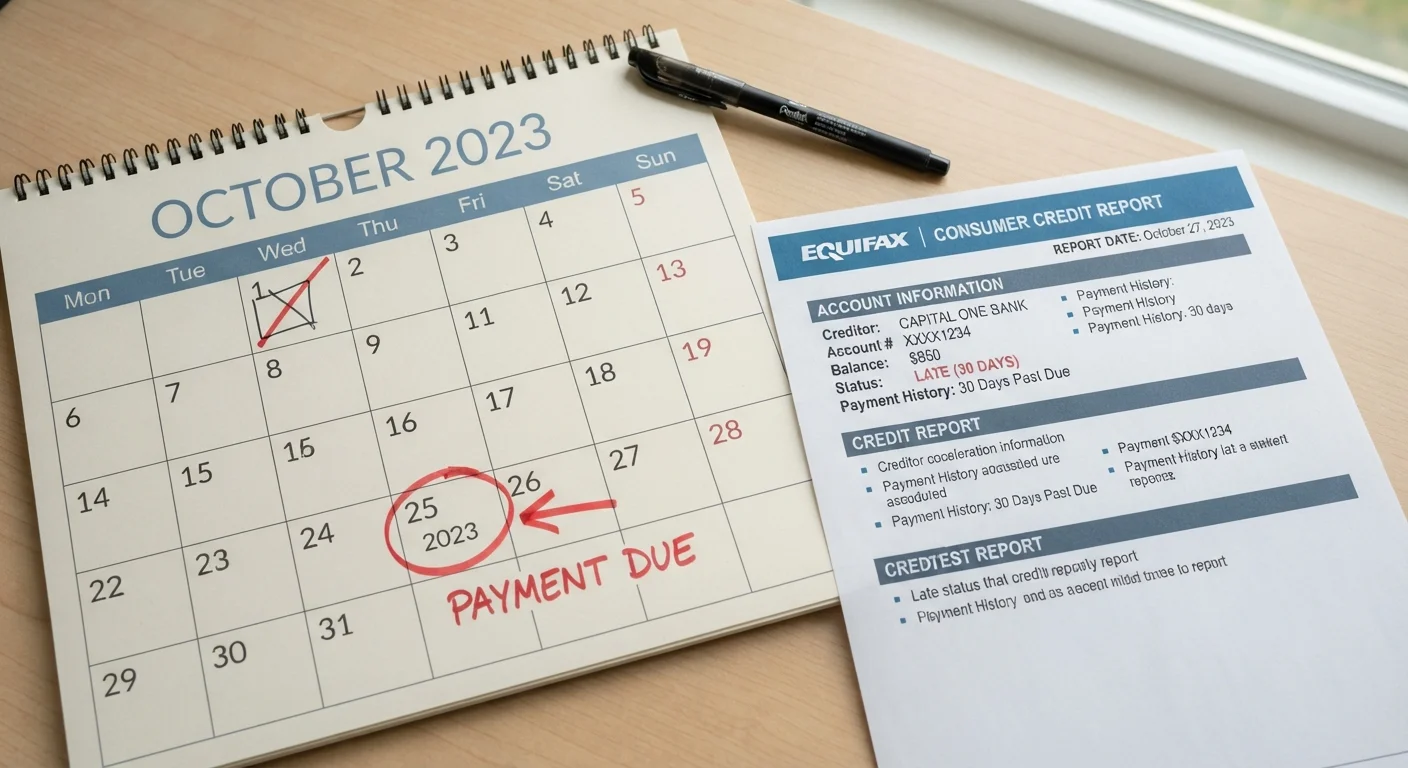
Photo credit: SkripTee.com | Search. Explore. Learn.
In this article
Late and missed payments can have lasting effects on your credit profile. Here's a factual look at the timeline and the factors that influence the impact.
Key Takeaways
- Payment history is the largest single factor in most credit scoring models, making missed payments especially damaging.
- A creditor typically reports a late payment to the bureaus only after it is 30 days past due - not the day after you miss it.
- The drop in your score is generally larger if your score was higher before the missed payment.
- The negative item can stay on your credit report for up to seven years, though its impact fades over time.
- Catching up on a missed payment quickly limits further damage, but the reported delinquency itself does not disappear immediately.
- Consulting a nonprofit credit counselor can help if you're struggling to manage multiple overdue accounts.
The 30-Day Threshold: What Actually Triggers a Credit Report Entry
Many people assume that a payment missed by a single day is immediately flagged to the credit bureaus. In practice, that is not how the system works. Most lenders and credit card issuers will not report a payment as delinquent until it is at least 30 days past the original due date. Before that point, you may face a late fee, and in some cases a penalty interest rate, but your credit report remains unaffected.
This window matters. If you realize you missed a due date within the first few weeks, making the payment immediately can prevent any credit bureau impact entirely. The critical reporting thresholds to understand are 30, 60, 90, and 120 days past due - each milestone that passes without payment typically means a new, more severe delinquency entry added to your report.
Late Fees vs. Credit Report Impact Are Different Things
A payment that is one day late may trigger a late fee from your lender, but it will not appear as a delinquency on your credit report until it is at least 30 days past due. These are two separate consequences - financial and credit-related - that operate on different timelines. Always read your cardmember agreement to understand your lender's specific late-fee and reporting policies.
To understand how your payment history fits into the broader calculation of your score, see our explainer on how credit scores are calculated.
How Much Your Score Can Drop - and Why It Varies
There is no single universal answer to how many points you will lose from one missed payment, because credit scoring models weigh multiple variables simultaneously. Two factors have an outsized influence:
- Your score before the miss: Counterintuitively, consumers with higher scores before the delinquency tend to experience a larger point drop. A person with a 780 score generally loses more points from a single 30-day late than someone with a 620 score, because the higher-score profile is more anomalous relative to an otherwise clean history.
- How late the payment becomes: A 30-day late is significantly less damaging than a 90-day late. Each additional 30-day milestone compounds the negative signal to scoring models.
35%
Weight of payment history in FICO score calculation
According to FICO, payment history is the single largest factor in its scoring model, outweighing credit utilization, length of history, and other variables.
7 years
How long a missed payment stays on your credit report
The Fair Credit Reporting Act (FCRA) limits most negative items, including late payments, to a maximum reporting period of seven years from the date of the original delinquency.
30 days
Minimum days late before lenders typically report to bureaus
Most major creditors follow a 30-day reporting threshold, meaning a payment missed by less than 30 days may not appear on your credit report at all if resolved in time.
Other variables include the total number of accounts on your report, your overall utilization rate, and the age of your credit history. Payment history, however, is weighted more heavily than any of these. The myths around credit scoring often understate just how much a single late payment can cost you in points.
The Seven-Year Clock and How Impact Fades Over Time
Under the Fair Credit Reporting Act (FCRA), a missed or late payment can appear on your credit report for up to seven years from the date of the first delinquency. That is a long tail - but the practical impact is not uniform across the entire period.
Credit scoring models place greater weight on recent activity than on older history. A 30-day late payment from five years ago, surrounded by consistent on-time payments since then, will have a far smaller effect on your current score than a delinquency from six months ago. This means that re-establishing a strong payment pattern after a miss is one of the most effective ways to rebuild your profile, even while the negative item remains on your report.
Autopay Is Your Simplest Safety Net
Setting up automatic payments for at least the minimum amount due on each account eliminates the risk of forgetting a due date. You can always pay more than the minimum manually - but autopay ensures you never accidentally cross the 30-day delinquency threshold due to an oversight.
The broader pattern of habits matters too. Our guide on habits that gradually erode a healthy credit profile explores the slow-building behaviors that compound over time alongside acute events like missed payments.
Practical Steps to Limit the Damage
If you have already missed a payment, your priority should be to act quickly and then build forward:
- Pay immediately. If you are still within the 30-day window, pay the minimum before the reporting threshold hits. Every day counts.
- Contact your lender. Many creditors have hardship programs or may offer a one-time courtesy waiver, particularly for long-standing customers with an otherwise clean history. Ask directly - the worst they can say is no.
- Set up autopay. Enrolling in autopay for at least the minimum payment on each account prevents future misses due to oversight or scheduling errors.
- Monitor your credit report. Under federal law, you are entitled to free credit reports from the three major bureaus. Review them to confirm what has and has not been reported, and dispute any inaccuracies through the bureau's formal process.
- Seek nonprofit counseling if needed. If you are managing multiple overdue accounts, a nonprofit credit counseling agency accredited by the National Foundation for Credit Counseling (NFCC) can help you develop a structured repayment plan.
If you are curious how a damaged credit profile affects major financial decisions, see our article on what your credit score does to your auto loan for a concrete example of the downstream costs.
This article is for general informational and educational purposes only and does not constitute personalized financial or legal advice. For guidance specific to your situation, consult a qualified financial professional.
Frequently Asked Questions

Author
Finance Editorial Team
Finance Editorial Team is the collective byline for our editorial team and contributor network. Articles published under this byline or an editorial pen name are researched, written, and reviewed according to our editorial standards for clarity, consistency, and independence before publication.
View all articles →