
Loose Leaf Tea vs Tea Bags: What Changes in the Cup
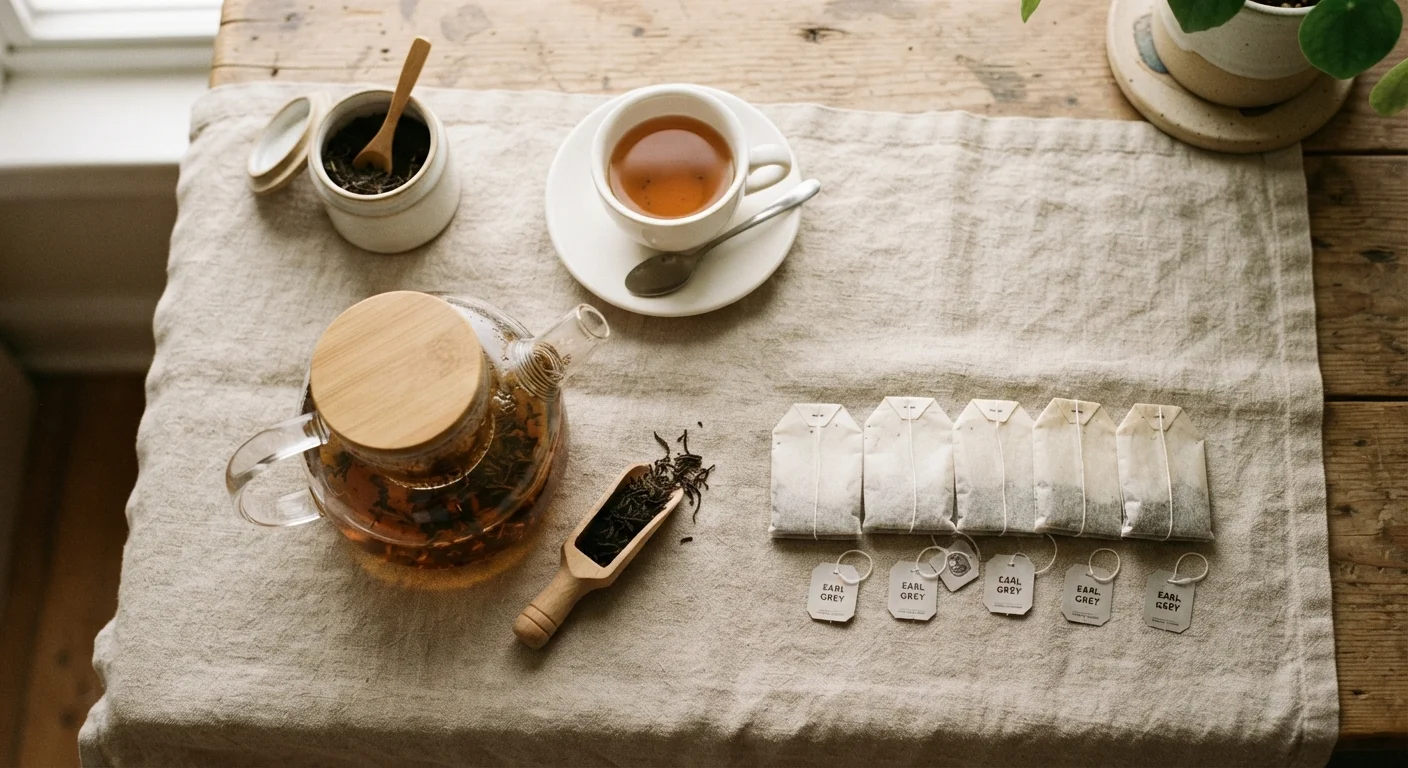
Photo credit: SkripTee.com | Search. Explore. Learn.
In this article
Beyond ritual and aesthetics, does brewing method actually affect flavour? An honest look at what the research and tasters suggest.
Key Takeaways
- Loose leaf tea typically contains larger, more intact leaves that preserve volatile aromatic compounds better than fannings.
- Standard tea bags usually contain smaller leaf particles called fannings or dust, which brew faster but with less complexity.
- Neither format is inherently superior - quality within each category varies enormously by tea grade and origin.
- Whole-leaf teas generally allow multiple steepings; most tea bags are designed for a single use.
- Water quality and temperature affect both formats equally, and are often more impactful than leaf format alone.
What's Actually Inside Each Format
The physical difference between loose leaf tea and tea bags isn't just packaging - it starts with the leaf itself. Loose leaf teas are typically made from whole or large-cut leaves that are processed to preserve their essential oils, polyphenols, and aromatic compounds. When steeped, these leaves have room to expand and release their character gradually into the water.
Standard tea bags, by contrast, most commonly contain fannings or dust - small particles left over after larger leaves are sorted and sold separately. These grades aren't inferior by accident; they were historically the commodity-grade leaves suited to uniform blending and fast brewing for mass-market consumption. Their increased surface area means they infuse quickly, which suits the tea bag format, but also means many volatile aromatic compounds escape during storage more readily than they do in intact leaves.
It's worth noting that pyramid-style mesh bags represent a genuine middle ground. Designed to hold larger leaf cuts, they give leaves more room to expand, often producing a cup closer in character to a basic loose leaf brew. Quality in this format varies considerably, so the tea inside the bag matters as much as the bag's shape. To understand how processing affects a tea's character before it ever reaches the bag, see our guide to how one plant becomes four distinct tea categories.
How Brewing Format Affects Flavour and Aroma
Tea flavour is the result of a complex interplay between leaf chemistry, water, temperature, and time. The format - loose or bagged - influences primarily how efficiently and evenly extraction occurs.
Loose leaf teas steeped in a roomy infuser or teapot allow leaves to unfurl fully, releasing tannins, catechins, and aromatic compounds at a rate closer to how they'd behave in a traditional gongfu-style preparation. The result is often a more layered flavour profile: brightness up front, body in the middle, and a lingering finish. High-quality oolongs, for example, can reveal distinctly different characteristics across a second or third steep - something a standard tea bag cannot replicate.
Fanning-grade tea in a standard bag extracts very quickly and uniformly, which produces consistent strength but less aromatic nuance. The cup is often more astringent due to the rapid release of tannins. For strongly milk-forward tea traditions - like a classic builder's brew - this robust, fast extraction is actually desirable. Neither outcome is wrong; they're designed for different purposes.
| Criterion | Loose Leaf Tea | Tea Bags |
|---|---|---|
| Leaf grade | Whole or large-cut leaves | Fannings or dust (typically) |
| Flavour complexity | Higher - layered, nuanced | Lower - robust, uniform |
| Brew speed | 3-5+ minutes depending on style | 2-4 minutes for most types |
| Resteeping | Often 2-4 steeps possible | Designed for single use |
| Equipment needed | Infuser, teapot, or strainer | Cup and hot water only |
| Environmental footprint | Fully biodegradable | May contain plastic sealant |
| Cost per session | Higher upfront, lower per steep | Low and predictable |
Water quality is a variable that affects both formats equally and is frequently underestimated. Our guide on how water quality affects tea and coffee flavour explains why mineral content and pH can shift a brew as dramatically as the tea format itself.
Practical Considerations: Cost, Waste, and Resteeping
Beyond flavour, the choice between formats involves real-world trade-offs. Loose leaf teas - particularly single-origin and specialty grades - tend to cost more per unit weight, but their resteeping potential often offsets the price per cup. A quality oolong or white tea steeped two to three times stretches one session's worth of leaves significantly further than a single-use bag.
Environmental considerations are also worth acknowledging. Many standard tea bags contain a small percentage of polypropylene plastic to heat-seal the bag, which means they do not fully compost. Loose leaf tea, steeped without any bag, produces only biodegradable plant waste. Consumers who compost may find loose leaf a cleaner option, though an increasing number of brands now produce fully compostable or plastic-free bags.
A Note on Specialty Tea Bags
The gap between loose leaf and bagged tea has narrowed in recent years. A growing number of specialty tea producers now sell higher-grade leaves - including single-estate Darjeelings and Taiwan oolongs - in spacious pyramid bags. These products don't always perform identically to the same leaf brewed loose, but they can deliver a meaningfully more complex cup than commodity-grade bags. Reading ingredient and origin information on packaging is the most reliable way to gauge what you're actually buying.
For those tracking caffeine intake, it's worth knowing the format alone doesn't reliably predict caffeine content - the tea type and steep time matter far more. Our piece on caffeine levels across popular beverages breaks this down in practical terms.

Author
Food Editorial Team
Food Editorial Team is the collective byline for our editorial team and contributor network. Articles published under this byline or an editorial pen name are researched, written, and reviewed according to our editorial standards for clarity, consistency, and independence before publication.
View all articles →