
What 'Natural Wine' Actually Means
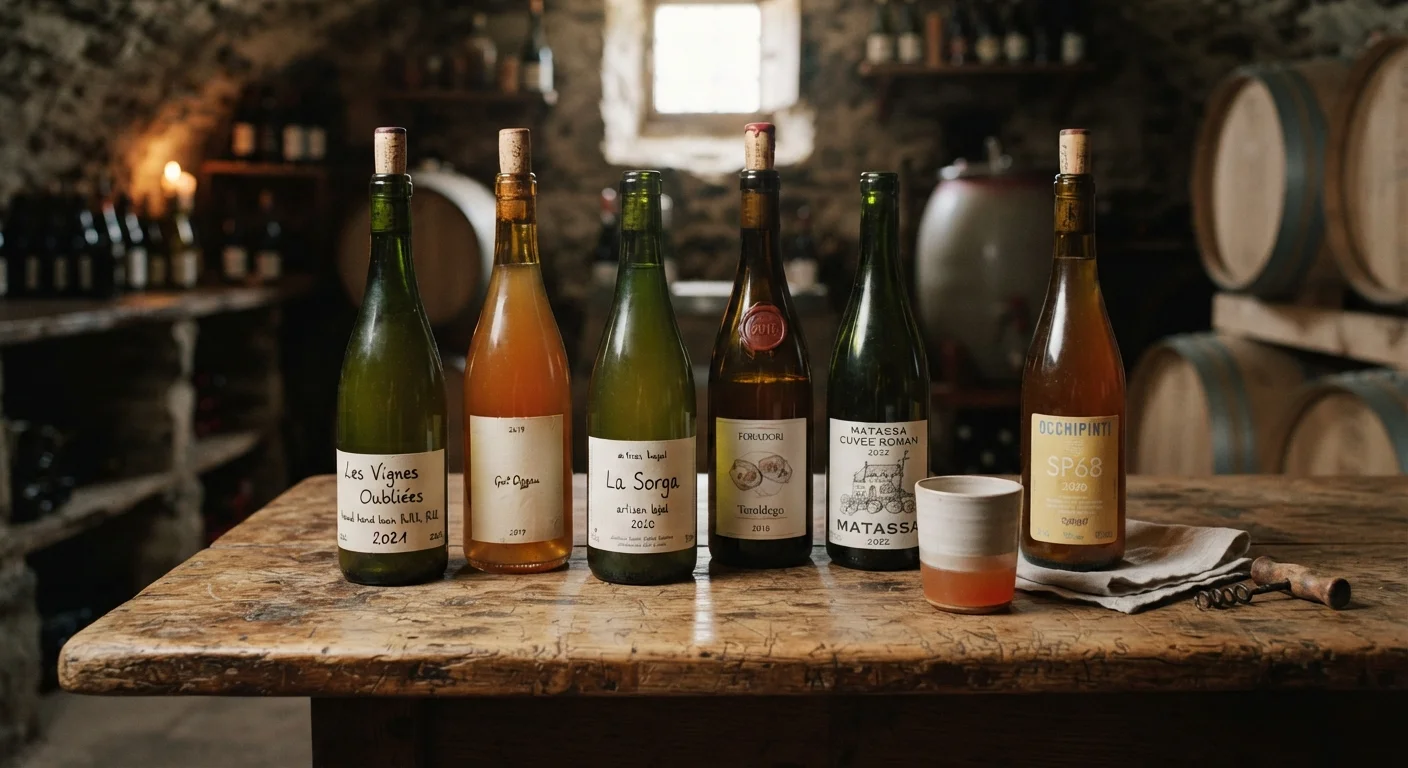
Photo credit: SkripTee.com | Search. Explore. Learn.
In this article
Natural wine is everywhere, but the term has no legal definition. Unpack what producers, critics, and drinkers actually mean by it.
Key Takeaways
- There is no legal or regulatory definition of 'natural wine' in the United States.
- Most producers use the term to mean minimal intervention in both the vineyard and cellar.
- Natural wines may taste different from conventional wines - sometimes intentionally so.
- Sulfites are not automatically absent; many natural winemakers add small amounts at bottling.
- Health claims around natural wine are not supported by strong scientific evidence.
A Term Without a Legal Definition
Walk into almost any urban wine shop or trendy restaurant and you'll encounter a section labeled 'natural wine.' The bottles often feature whimsical labels, the staff speak about them with enthusiasm, and the prices range widely. What you won't find is a government-issued definition, because in the United States - and in most wine-producing countries - no legal standard for 'natural wine' exists.
Unlike 'organic,' which carries USDA certification requirements, or 'biodynamic,' which has private certification bodies such as Demeter, 'natural wine' is an informal, community-driven category. This doesn't mean it's meaningless. It means the term is defined by producer philosophy and community consensus rather than regulation. Understanding what most producers and advocates actually mean by it helps you make more informed choices when you're navigating a wine list.
The working definition shared by most natural wine producers emphasizes two broad principles: minimal intervention in the vineyard (often organic or biodynamic farming, hand harvesting) and minimal intervention in the cellar (native yeasts, no or low added sulfites, no fining or filtration). Beyond those, practices vary considerably from producer to producer.
Common Myths About Natural Wine - Corrected
The natural wine world attracts strong opinions from advocates and skeptics alike. Many popular claims - on both sides - don't hold up under scrutiny. Here are the most persistent misconceptions, alongside what the evidence and expert consensus actually support.
Myth
Natural wine contains zero sulfites, making it safer and better for everyone.
Fact
Many natural winemakers add small amounts of sulfites at bottling; even additive-free wines contain naturally occurring sulfites from fermentation.
Sulfur dioxide (SO₂) is a byproduct of yeast activity, meaning every wine contains some level of it regardless of winemaking philosophy. The phrase 'no added sulfites' is accurate for some producers, but 'sulfite-free' is essentially impossible. Additionally, sulfite sensitivity affects a small portion of the population, predominantly those with asthma. The FDA estimates fewer than 1% of Americans are sulfite-sensitive. For most people, sulfite levels in wine - natural or conventional - are not a health concern. Headaches are more commonly associated with alcohol itself, histamines, or dehydration than with sulfites.
Myth
Natural wine is automatically organic or certified biodynamic.
Fact
Many natural wine producers farm organically or biodynamically, but 'natural wine' carries no certification requirement of its own.
Some natural wine producers hold formal organic or biodynamic certifications; others follow similar practices without pursuing certification, often citing cost or bureaucratic barriers. The absence of certification doesn't mean a producer uses pesticides, but it does mean there's no third-party verification. Conversely, a wine can be certified organic and still involve significant cellar interventions - such as commercial yeast additions or heavy filtration - that most natural wine advocates would consider disqualifying. The categories overlap but are not identical.
Myth
Natural wine is always cloudy and tastes funky or sour - it's just 'off' wine.
Fact
Haze and some aromatic complexity are deliberate stylistic choices, but natural wines span a wide sensory range from pristine and precise to wildly expressive.
Cloudiness in unfiltered wine typically comes from harmless yeast particles or grape proteins - it is not a sign of spoilage. Some natural wines do display volatile acidity or Brettanomyces (brett) character that certain palates find challenging, and there is legitimate debate within the wine world about where 'expressive' ends and 'flawed' begins. However, many natural wines are crystal clear, restrained, and technically impeccable. Dismissing the entire category based on one funky bottle is like dismissing all craft beer because you encountered an over-fermented batch.
Myth
Drinking natural wine instead of conventional wine has proven health benefits.
Fact
No strong scientific evidence currently supports the claim that natural wine is healthier than conventional wine for the general population.
Claims that natural wine produces fewer hangovers, is gentler on digestion, or delivers superior antioxidants are largely anecdotal. Research into the specific health effects of winemaking additives at typical consumption levels is limited, and no major health authority endorses natural wine as a healthier alternative. Alcohol itself carries well-documented health risks at regular consumption, regardless of how the wine was made. Anyone making personal health decisions around alcohol should consult a qualified healthcare professional rather than relying on beverage marketing language.
Myth
Natural wine is a modern trend invented by Instagram-savvy sommeliers.
Fact
Low-intervention winemaking has centuries of precedent; the current movement crystallized in France in the 1980s around figures like Jules Chauvet.
Before industrial additives and laboratory yeasts became widespread in the mid-20th century, most wine was made with minimal intervention by necessity. The contemporary natural wine movement is often traced to Beaujolais in France, where producers influenced by the late négociant and chemist Jules Chauvet began explicitly rejecting chemical inputs in the 1980s. The movement gained momentum in Paris bistros and spread globally through wine fairs like RAW WINE. The current social media visibility of natural wine amplifies an existing philosophy rather than inventing one.
What to Realistically Expect in the Glass
Natural wines can taste strikingly different from their conventional counterparts. Because they often ferment with indigenous (wild) yeasts and undergo minimal filtration, they may be hazy, slightly fizzy, or show what winemakers call 'funky' or 'barnyard' aromas. These qualities are features to some drinkers and flaws to others - and that's a matter of personal preference, not quality failure.
~350
Permitted additives in conventional US winemaking
The TTB (Alcohol and Tobacco Tax and Trade Bureau) maintains a list of allowable winemaking materials; conventional wine production permits a broad range of processing aids not commonly disclosed on labels.
<1%
Americans with sulfite sensitivity
The FDA estimates that fewer than 1% of the U.S. population has a genuine sulfite sensitivity, primarily affecting people with asthma.
Stability can also differ. A wine made without preservatives may evolve more rapidly once opened and may be more sensitive to heat during shipping and storage. If you're new to natural wine, buying from a shop with knowledgeable staff and good storage conditions is worthwhile. Learning to read a wine label can also reveal clues about how a wine was made, even when a producer doesn't use the 'natural' label explicitly.
Storage and Shelf Life Matter More Here
Natural wines, particularly those made without added sulfites, are generally less stable than heavily preserved conventional wines. They can deteriorate more quickly when exposed to heat, light, or improper storage. If you're aging a natural wine or shipping it during warm months, pay close attention to handling conditions. When in doubt, drink these wines relatively young and keep them refrigerated or in a cool, dark place.
How Natural Wine Fits Into a Broader Conversation About Food Labeling
The ambiguity around 'natural wine' mirrors a broader challenge in food and beverage marketing: terms like 'natural,' 'clean,' and 'wholesome' carry emotional weight without legal teeth. Similar dynamics appear when consumers evaluate claims about coffee processing - the word 'natural' in coffee processing describes a specific technique, not a health status - or when parsing what a 'balanced diet' actually requires.
Educated curiosity is your best tool. Ask producers or sommeliers specific questions: Do you farm organically? Do you use native yeasts? How much sulfite, if any, is added? These concrete questions will get you much further than relying on a label that no one is legally required to define. Natural wine can be genuinely expressive, terroir-driven, and delicious - but it benefits from the same critical engagement you'd bring to any food or drink claim.

Author
Food Editorial Team
Food Editorial Team is the collective byline for our editorial team and contributor network. Articles published under this byline or an editorial pen name are researched, written, and reviewed according to our editorial standards for clarity, consistency, and independence before publication.
View all articles →