
Adaptive Cruise Control and Lane Assist: What These Systems Do - and What They Don't
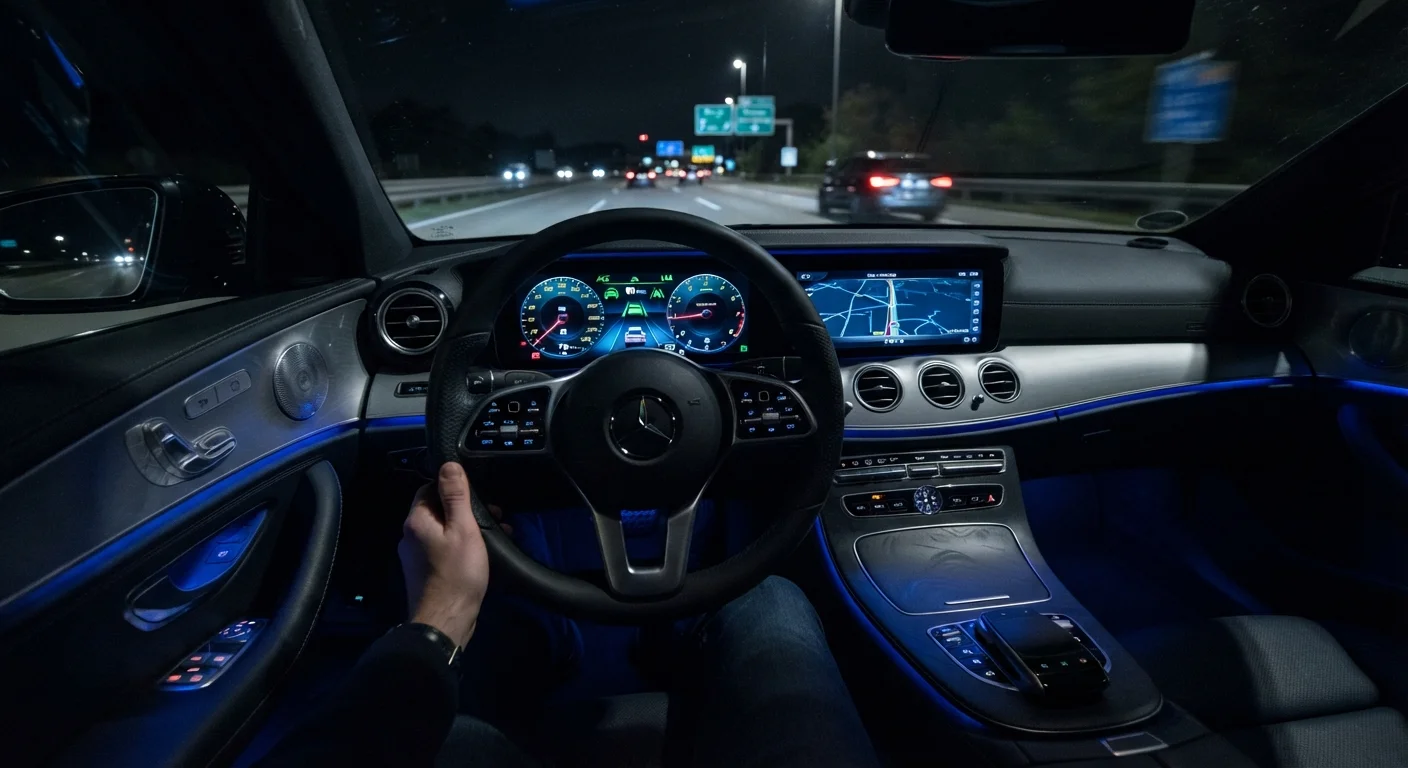
Photo credit: SkripTee.com | Search. Explore. Learn.
In this article
Driver assistance features are increasingly common, but they're often misunderstood. Here's what these systems genuinely handle and where human attention still applies.
Key Takeaways
- Adaptive cruise control maintains a set following distance but does not replace the need for driver attention.
- Lane assist systems warn or nudge - they are not capable of steering the car autonomously.
- Both systems have documented limitations in poor weather, faded road markings, and complex traffic scenarios.
- Overreliance on these features has been linked to reduced driver vigilance, according to safety researchers.
- Drivers remain legally and practically responsible for vehicle control at all times.
Reduces fatigue on long highway drives
By automating speed adjustments in light traffic, ACC lowers the repetitive low-level demand on drivers, which can help preserve attention for higher-priority decisions over long distances.
Maintains consistent following distance
ACC uses sensors to hold a preset gap from the vehicle ahead, which can reduce the risk of rear-end collisions caused by inattentive speed management in flowing traffic.
Lane drift warnings add a safety buffer
Lane departure alerts give drivers an early nudge when unintentional drifting occurs, which is particularly useful during fatigue-related micro-lapses in attention.
Can reduce rear-end collision risk in some conditions
Studies have shown that vehicles equipped with automatic emergency braking - often paired with ACC sensors - are involved in fewer rear-end crashes than those without the feature.
Cannot handle all traffic scenarios reliably
Cut-ins, stationary objects, and unusual traffic patterns can confuse ACC sensors, and the system may respond slower than an alert human driver or fail to respond correctly.
Lane assist fails with poor or absent road markings
Faded paint, construction overlays, or unmarked shoulders can cause lane-keeping systems to disengage unexpectedly or apply erroneous steering inputs.
Encourages reduced driver vigilance over time
Safety researchers have documented a tendency for drivers using partial automation to monitor the road less actively, creating a gap between expected and actual driver readiness.
Performance degrades in adverse weather
Heavy rain, snow, and fog can impair the cameras and radar sensors that both systems rely on, reducing reliability precisely when driving conditions are most demanding.
Drivers remain fully legally responsible
No current production vehicle sold in the US operates at a level of automation that removes driver responsibility. Assuming otherwise can lead to dangerous gaps in oversight.
What These Systems Actually Do
Adaptive cruise control (ACC) and lane-keeping assist (LKA) are two of the most widely available driver assistance technologies on the market today. They're often bundled under the broader label of Advanced Driver Assistance Systems, or ADAS. Understanding how each one works - mechanically and in practice - is the foundation for using them safely.
Adaptive cruise control builds on traditional cruise control by adding radar or camera sensors that monitor the vehicle ahead. Instead of holding a fixed speed, ACC automatically adjusts your speed to maintain a preset following distance. If the car ahead slows, your vehicle slows. If they accelerate, you accelerate back toward your set speed. Some versions can bring the vehicle to a full stop in slow traffic and resume automatically.
Lane-keeping assist uses forward-facing cameras to detect lane markings. Depending on the system, it either alerts the driver with an audible tone or steering wheel vibration when the vehicle drifts, or it applies gentle steering corrections to nudge the car back toward center. More advanced versions - sometimes called lane centering - work continuously to keep the car positioned in the middle of the lane rather than just reacting to drift.
These systems are designed to work as a pair on highway-style roads. They are not designed for city driving, construction zones, or situations where lane markings are absent or ambiguous. For a broader look at how highway and city driving demand different skills, see how the two environments differ.
The Genuine Benefits
When used as intended, both systems offer measurable practical value.
Reduces fatigue on long highway drives
By automating speed adjustments in light traffic, ACC lowers the repetitive low-level demand on drivers, which can help preserve attention for higher-priority decisions over long distances.
Maintains consistent following distance
ACC uses sensors to hold a preset gap from the vehicle ahead, which can reduce the risk of rear-end collisions caused by inattentive speed management in flowing traffic.
Lane drift warnings add a safety buffer
Lane departure alerts give drivers an early nudge when unintentional drifting occurs, which is particularly useful during fatigue-related micro-lapses in attention.
Can reduce rear-end collision risk in some conditions
Studies have shown that vehicles equipped with automatic emergency braking - often paired with ACC sensors - are involved in fewer rear-end crashes than those without the feature.
On long highway drives, ACC in particular reduces the mental load of constantly monitoring and adjusting speed in light traffic. That reduction in low-level cognitive demand can help drivers stay more alert for genuinely important decisions - merging, responding to hazards, managing blind spots. See our guide on merging and lane changes for context on where driver judgment remains essential.
~40%
Reduction in rear-end crashes with AEB
The Insurance Institute for Highway Safety has reported that automatic emergency braking - a technology closely related to ACC sensors - is associated with meaningful reductions in rear-end crash rates.
Level 2
SAE automation level of most ACC + lane assist systems
According to SAE International's automation framework, most production vehicles with ACC and lane assist operate at Level 2 - meaning the driver must remain engaged and in control at all times.
The Real Limitations - and Where Drivers Get It Wrong
These features are routinely misunderstood, and the consequences of that misunderstanding can be serious.
Cannot handle all traffic scenarios reliably
Cut-ins, stationary objects, and unusual traffic patterns can confuse ACC sensors, and the system may respond slower than an alert human driver or fail to respond correctly.
Lane assist fails with poor or absent road markings
Faded paint, construction overlays, or unmarked shoulders can cause lane-keeping systems to disengage unexpectedly or apply erroneous steering inputs.
Encourages reduced driver vigilance over time
Safety researchers have documented a tendency for drivers using partial automation to monitor the road less actively, creating a gap between expected and actual driver readiness.
Performance degrades in adverse weather
Heavy rain, snow, and fog can impair the cameras and radar sensors that both systems rely on, reducing reliability precisely when driving conditions are most demanding.
Drivers remain fully legally responsible
No current production vehicle sold in the US operates at a level of automation that removes driver responsibility. Assuming otherwise can lead to dangerous gaps in oversight.
The most common failure mode isn't a technology glitch - it's a driver assuming the system is handling more than it is. Research from the Insurance Institute for Highway Safety and other organizations has found that drivers using partial automation features sometimes reduce their visual scanning and hand-on-wheel readiness, even when system guidelines explicitly require both.
Lane assist systems are particularly sensitive to road conditions. Faded lane markings, temporary construction markings, or roads with complex curve geometry can cause the system to perform erratically or disengage without warning. Similarly, ACC struggles in scenarios involving vehicles that cut in close at high speed - the reaction time of the system may not match what a fully alert driver could achieve.
Understanding how in-car distractions divide attention is directly relevant here: a driver who is mentally disengaged because they believe the car is "handling it" is still a distracted driver.
What 'Level 2 Automation' Actually Means
SAE International, the engineering standards organization, defines vehicle automation on a scale from Level 0 (no assistance) to Level 5 (full self-driving). Most consumer vehicles with ACC and lane assist are Level 2 - meaning the system can control speed and steering simultaneously, but a human driver must remain attentive and ready to take over immediately. Level 2 is sometimes called 'partial automation,' but this label can be misleading: the driver is not a passenger. The vehicle is not driving itself.
How to Use These Features Responsibly
Driver assistance technology is most effective when it's treated as exactly that - assistance, not automation. A few practical principles apply regardless of which vehicle or system you're using.
Read your owner's manual. Each manufacturer implements ACC and lane assist differently. Speed thresholds, automatic disengagement conditions, and override procedures vary significantly. Your manual is the authoritative source for your specific vehicle. Our guide on using your owner's manual effectively explains how to navigate it.
Keep your hands on the wheel and eyes on the road. Every major ACC and lane assist system on the market currently requires this. Torque sensors in many systems will alert or disengage if hands-off periods are detected. This isn't a technicality - it reflects the genuine operational boundary of the technology.
Disengage in complex situations. Construction zones, heavy rain, snow, and dense urban traffic are conditions where manual control is more reliable. Know how to quickly and smoothly override or disable the systems when conditions call for it.
Pairing these habits with defensive driving principles gives you the full picture of how to stay safe whether or not assistance features are active.

Author
Autos Editorial Team
Autos Editorial Team is the collective byline for our editorial team and contributor network. Articles published under this byline or an editorial pen name are researched, written, and reviewed according to our editorial standards for clarity, consistency, and independence before publication.
View all articles →