
Defensive Driving: What It Actually Means and Why It Matters
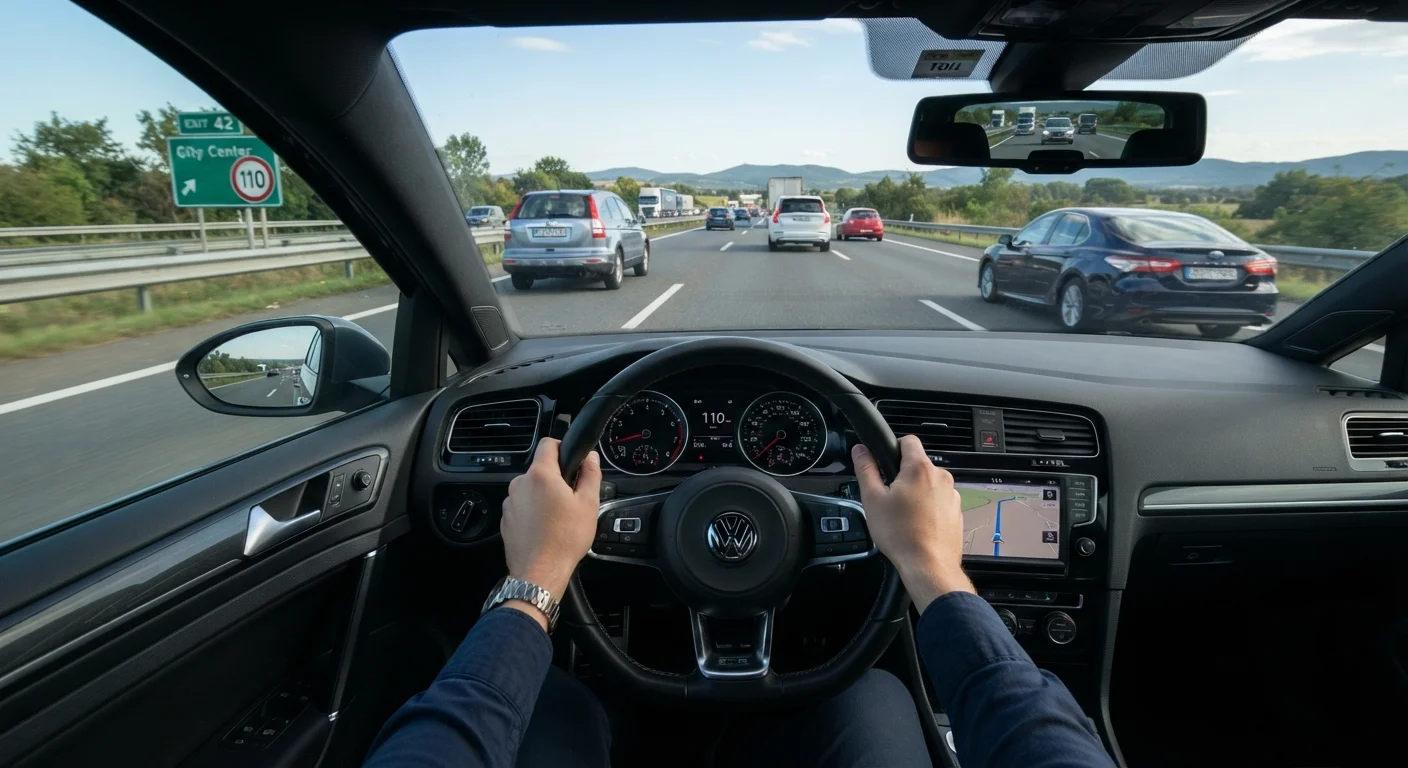
Photo credit: SkripTee.com | Search. Explore. Learn.
In this article
Defensive driving goes beyond following the rules. Learn the core principles that help drivers anticipate hazards and reduce collision risk.
Key Takeaways
- Defensive driving is proactive - it focuses on anticipating hazards, not just reacting to them.
- Maintaining a safe following distance is one of the most effective defensive driving habits.
- Scanning ahead and checking mirrors regularly gives you more time to respond to developing situations.
- No driver assistance technology replaces sustained human attention and judgment.
- Environmental conditions like rain, darkness, and heavy traffic require active adjustments to speed and spacing.
More Than Following the Rules
Most drivers consider themselves safe if they obey speed limits, stop at red lights, and signal before changing lanes. Those habits matter - but they describe the legal minimum, not what it means to drive defensively. Defensive driving closes the gap between what the law requires and what the road actually demands.
The key distinction is anticipation versus reaction. A reactive driver hits the brakes when a hazard appears. A defensive driver recognizes conditions that make a hazard likely and adjusts before anything goes wrong. That might mean slowing down when a ball rolls into the street before a child follows it, or easing off the accelerator when a merging driver hasn't yet checked their mirror.
This proactive posture is what separates drivers who rarely have close calls from those who frequently describe near-misses as bad luck. Luck is rarely the determining factor - preparation usually is. For a broader look at how these skills apply across road environments, see our complete guide to safe driving in all conditions.
The Core Principles in Practice
Defensive driving isn't a single technique - it's a cluster of habits applied together. These are the ones that make the most consistent difference:
- Maintain a meaningful following distance. The common rule of keeping a three-second gap between your vehicle and the one ahead is a useful starting point - but conditions often require more. Rain, darkness, heavy loads, and fatigue all extend your stopping distance. Closing in on the car ahead eliminates your margin for error. Our article on why following distance is one of the most underrated safety margins explains the physics and habits in detail.
- Scan well ahead, not just immediately in front. Looking 10-15 seconds down the road gives you time to process what's developing - brake lights clustering, a lane narrowing, a pedestrian stepping toward the curb. Drivers who focus only on the car directly ahead are perpetually surprised.
- Manage your speed for actual conditions. The posted speed limit is the legal maximum under ideal conditions. Fog, rain, construction zones, and heavy traffic all call for lower speeds even when they're within the legal limit.
- Eliminate distractions actively. Phones are the obvious culprit, but distraction also includes passengers, music, and internal preoccupation. Defensive driving requires mental presence - not just physical occupation of the seat.
- Stay visible and position yourself with options. Avoid lingering in other drivers' blind spots. Keep space to your sides when possible so you have somewhere to go if a lane change is needed in a hurry.
Use the Two-Second Rule as a Floor, Not a Target
Many drivers treat the two- or three-second following distance rule as an ideal to hit rather than a minimum to exceed. In wet weather, reduced visibility, or heavy traffic, doubling your following distance to six or more seconds is a straightforward way to give yourself significantly more response time without any added effort.
When Conditions Change, So Must You
One of the most common errors drivers make is treating the road as a fixed environment. In reality, conditions shift constantly - and defensive driving means recalibrating continuously rather than maintaining a fixed autopilot.
Rain, for example, reduces traction, limits visibility, and dramatically increases stopping distance. The same speed that felt safe on a dry highway can lead to hydroplaning on a wet one. Our article on driving in heavy rain covers what changes and how to adapt. Similarly, darkness degrades depth perception and reaction time in ways many drivers underestimate - a topic explored in our piece on night driving habits that increase risk.
The defensive driver's response to changing conditions isn't panic - it's a calm, methodical adjustment: reduce speed, increase following distance, heighten visual scanning frequency, and reduce reliance on assumptions about how others will behave.
Urban and Highway Conditions Require Different Adjustments
Defensive techniques look different depending on where you're driving. City streets introduce pedestrians, cyclists, and frequent intersection conflicts; highways bring high-speed merges and fatigue over longer distances. The underlying principles - anticipation, spacing, and awareness - apply in both, but how you apply them shifts significantly with the environment.
Technology Assists - But Doesn't Replace - Defensive Driving
Modern vehicles come equipped with driver assistance features - adaptive cruise control, automatic emergency braking, lane-keep assist - that can meaningfully reduce collision risk. But these systems have well-defined limits, and misunderstanding those limits creates its own form of danger.
Adaptive cruise control, for instance, maintains a set following distance under normal highway conditions - but it may not respond fast enough in complex cut-in situations or at highway exit ramps. Lane assist helps prevent drifting but isn't a substitute for active steering attention. As we detail in our article on what adaptive cruise control and lane assist actually do, these features are designed to assist an engaged driver, not to replace one.
A defensive driver uses technology as an additional layer of protection - not as permission to disengage. That distinction is not just a safety principle; it's often spelled out explicitly in manufacturer documentation.
“The goal of driver education should be to develop judgment, not just skill. Skills deteriorate; judgment grows with experience and reflection.”
— National Safety Council, US nonprofit organization focused on eliminating preventable deaths and injuries
Driving environments also shape which skills matter most. Highway driving demands different attention than city streets - a distinction worth understanding if you regularly navigate both. See our comparison of highway versus city driving skills and risks for a practical breakdown.
Frequently Asked Questions

Author
Autos Editorial Team
Autos Editorial Team is the collective byline for our editorial team and contributor network. Articles published under this byline or an editorial pen name are researched, written, and reviewed according to our editorial standards for clarity, consistency, and independence before publication.
View all articles →